
Rhizoma Curcumae Zedoariae Zedoary Rhizome
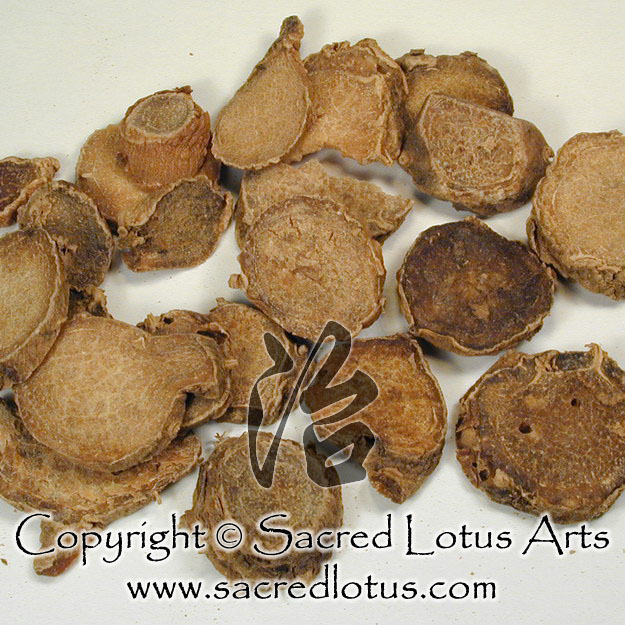
Materia Medica Data
- Temperature
- Warm
- Nature & Flavour
- Bitter, Spicy, Warm
- Channels Entered
- LIV, SP
- Latin (pharmaceutical)
- Rhizoma Curcumae Zedoariae
- Chinese
- 莪术
- Tone Marks
- é zhú
Chinese Herb Actions
What is E Zhu used for in Chinese medicine?
E Zhu (Curcuma zedoaria, zedoary rhizome) strongly breaks blood stasis and dissolves accumulations, and moves qi to relieve pain — it is one of the strongest blood-invigorating herbs, reserved for chronic or severe blood stasis, especially fixed abdominal or epigastric masses, when gentler blood-moving herbs have not worked.
- Breaks blood stasis, dissolves accumulations — used for stubborn blood stasis in the chong channel (e.g. amenorrhea with abdominal pain) and for palpable masses in the abdomen and epigastric region.
- Moves qi, relieves pain — epigastric and abdominal fullness, distension, and pain; promotes digestion by increasing qi and blood circulation, and treats chest/abdominal constriction from food stagnation.
Source: Sacred Lotus sources & references; cross-referenced against multiple online sources and Bensky, Materia Medica (3rd ed.).
Chinese Herb Dosage
What is the typical dosage of E Zhu?
Roughly 3–10 g in decoction — Bensky gives 3–9 g while Chen & Chen give 3–10 g; the ranges are essentially the same. Because of its strength, E Zhu is typically used for a limited course and is classically paired rather than used alone.
Source: Sacred Lotus sources & references (existing dosage data); cross-referenced against Bensky, Materia Medica (3rd ed.) and Chen & Chen, Chinese Medical Herbology and Pharmacology. Reference only, not a prescription.
Chinese Herb Contraindications & Cautions
Are there cautions for E Zhu, especially in pregnancy?
E Zhu carries a strong pregnancy contraindication and must not be used during pregnancy — it has been associated with teratogenic (birth-defect) effects in reference literature, in addition to its blood-breaking action being inherently risky in pregnancy. It is also unsuitable for deficiency patterns, blood-heat patterns, and cases without a genuine stubborn accumulation.
- Pregnancy — do not use. Reported teratogenic effects; blood-breaking action is a direct risk to pregnancy.
- Deficiency patterns — not appropriate; E Zhu is a strongly draining, breaking herb.
- Blood-heat patterns — avoid.
- Early menses, hypermenorrhea, or absence of stubborn accumulation — not indicated.
Source: Sacred Lotus sources & references; cross-referenced against multiple online sources. Safety information presented as a neutral reference fact, not usage instructions.
Chinese Herb Toxicity & Overdose
Reported possible side effects include dizziness, nausea, dyspnea, and rarely fever, cyanosis, anxiety, general weakness, and temporarily elevated liver enzyme (SGPT/ALT) levels. These are documented in materia medica references as reactions that can occur with E Zhu use; alongside the strong pregnancy contraindication, this supports professional supervision when this herb is used.
Source: Sacred Lotus sources & references; materia medica consensus (Bensky, Chen & Chen). Reference note, not a safety guarantee.
Herb-Drug Interactions
No well-established clinical herb–drug interactions are documented. Given its strong blood-invigorating action, practitioner awareness is reasonable for patients on anticoagulant or antiplatelet therapy — this is a precautionary note based on pharmacological plausibility, not a demonstrated clinical interaction.
Western / Biomedical Research
Chinese Herb Clinical Studies & Research
Provided as research context — a summary of published biomedical study, not a therapeutic or medical claim.
Is there modern research on E Zhu (Curcuma zedoaria)?
Yes — reviews report anti-inflammatory, analgesic, and antitumor (antineoplastic) activity for Curcuma zedoaria, based mainly on laboratory (in-vitro) and animal (in-vivo) studies rather than human trials. Zedoary is used across multiple traditional medicine systems (including Ayurveda) for conditions such as dyspepsia, flatulence, diarrhea, and cancer, and modern pharmacological screening has investigated many of these traditional claims.
- Anti-inflammatory / analgesic (preclinical) — in-vitro and animal studies support traditional anti-inflammatory and pain-relieving claims for zedoary extracts and its essential oil constituents.
- Antitumor (preclinical) — antineoplastic activity has been demonstrated in laboratory and animal models, consistent with zedoary's traditional use for cancer-related conditions in several ethnomedical systems; this is not clinical proof of anticancer efficacy in humans.
- Comparative Curcuma pharmacology — a review comparing Curcuma longa (turmeric) and Curcuma zedoaria within Islamic Traditional Medicine reports hepatoprotective, antifungal, antihypertensive, and neuroprotective properties across the genus, reflecting overlapping but not identical pharmacological profiles between these related species.
Human clinical trial evidence specific to E Zhu was not identified in this review; current support is preclinical. Treat as research context only.
Sources: PMID 19126292 (Lobo et al., J Pharm Pharmacol, 2009, comprehensive chemical/pharmacological/ethnomedicinal review); PMID 30947655 (Ayati et al., Curr Pharm Des, 2019, comparative review of C. longa and C. zedoaria). Research context, not a therapeutic claim.
Chinese Herb Notes
How is E Zhu different from San Leng, Yu Jin, and Jiang Huang?
E Zhu is classically paired with San Leng to reduce masses, but is a different genus from that pairing partner — while Yu Jin and Jiang Huang are Curcuma-genus relatives of E Zhu used for very different purposes, a real and common point of confusion.
- E Zhu + San Leng — the classic combination for breaking blood stasis and dissolving masses; the two are traditionally used together for stronger effect than either alone, for chronic abdominal/epigastric masses and stubborn blood stasis.
- Yu Jin (Curcuma tuber, Radix Curcumae) — a different Curcuma-genus herb (from the tuberous root rather than the rhizome) used to invigorate blood and move qi more gently than E Zhu, while also cooling the blood, clearing Heart heat, calming the spirit, and promoting bile flow (used for jaundice); it does not have E Zhu's mass-dissolving strength.
- Jiang Huang (Curcuma longa rhizome, turmeric) — also invigorates blood and moves qi, but is characteristically used for wind-damp painful obstruction and pain in the shoulders/limbs, not for internal masses.
- E Zhu (Curcuma zedoaria rhizome) — the strongest blood-breaker of the three, reserved for severe stasis and palpable masses, including its traditional popularity for masses associated with cancer, especially abdominal and cervical presentations.
(Traditional differentiation and formula context, not treatment advice.)
Source: Sacred Lotus sources & references; cross-referenced against multiple online sources and Bensky, Materia Medica (3rd ed.).
Sources & References
Compiled and edited by Thomas Dehli, Founder & Editor, Sacred Lotus Updated
The information here is referenced from numerous sources — teachers, practitioners, class notes from Five Branches University, the books below, and the published research literature, with citations given as resolvable PubMed identifiers. Where sources disagree, I have flagged the discrepancies directly. If facts couldn't be verified, I have left them out. How we source our content.
Reference information for students and practitioners — not medical advice. Consult a qualified practitioner. Terms of use.
Chinese Herbs Books & References
 https://amzn.to/3WfB3DK
 https://amzn.to/3DR1VUh
 https://amzn.to/42aMz73
 https://amzn.to/3PuD4bt