
Semen Benincasae Hispidae Winter Melon, Wax Gourd Seed, Benincasa
Also known as Dong Gua Ren
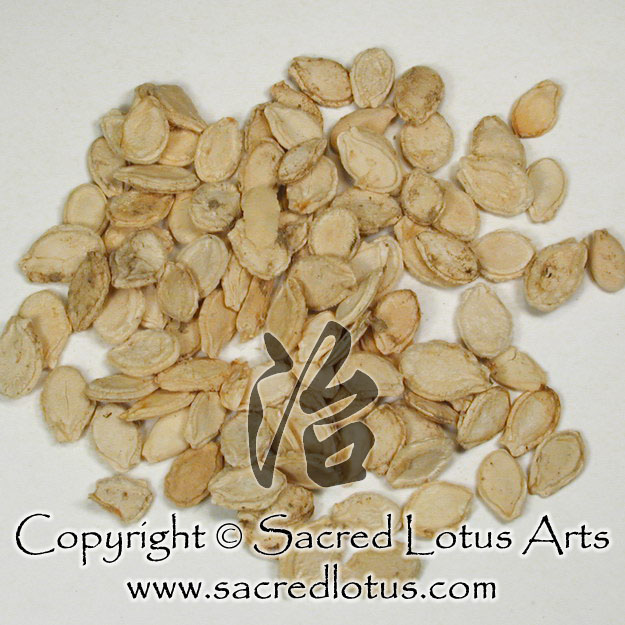
Materia Medica Data
- Temperature
- Cold
- Nature & Flavour
- Sweet, Cold
- Channels Entered
- LU, ST, LI, SI
- Latin (pharmaceutical)
- Semen Benincasae Hispidae
- Chinese
- 冬瓜子
- Tone Marks
- dōng guā zĭ
- Also Known As
- Dong Gua Ren
- Translation
- Winter Melon Seed
Chinese Herb Actions
What is Dong Gua Zi used for in Chinese medicine?
Dong Gua Zi is used to clear heat, expel phlegm and drain pus — it is the herb reached for in Lung abscess and intestinal abscess. This reference records it as sweet and cold, entering the Lung, Stomach, Large Intestine and Small Intestine channels, and classes it among the Herbs that Regulate Water and Drain Dampness. It is the seed of the winter melon (wax gourd), an everyday food plant, which keeps it among the gentler herbs in that group.
Its traditional actions, as carried in this reference's own record:
- Clears heat, expels phlegm and eliminates pus — for Lung and intestinal abscess, possibly with foul-smelling discharge, arising from heat in the Lung or Large Intestine; also for cough with thick yellow, foul-smelling sputum. This is the action that puts it into the two classical abscess formulas.
- Promotes urination and drains damp — for oedema and for vaginal discharge attributed to damp-heat.
Part used: the dried ripe seed of the winter melon, sometimes shelled and listed as the kernel — this reference records the alternate name Dong Gua Ren (冬瓜仁, "winter melon kernel"), which refers to the same material and is not a separate herb.
Source: this reference's own herb record (properties, channels, category, recorded actions) and its own formula records for Wei Jing Tang and Da Huang Mu Dan Tang; cross-referenced against multiple online sources and published materia medica consensus (Bensky, Materia Medica, 3rd ed.; Chen & Chen, Chinese Medical Herbology and Pharmacology). A review of the plant's traditional uses across Asian medical traditions likewise records use for cough with thick mucus (PMID 34925698, PMC 8683187). Traditional-use framing; not medical advice.
Chinese Herb Dosage
What is the typical dosage of Dong Gua Zi?
About 10–15 g in decoction, with a second reference in this collection giving 9–15 g — a close and unproblematic agreement. In formula use the quantities run considerably higher, because the herb is a bulky food seed rather than a concentrated medicinal.
- In this reference's own formula records — 24 g in Wei Jing Tang and 15–30 g in Da Huang Mu Dan Tang. Formula quantities and the general decoction range are answering different questions; both are given here rather than reconciled.
- Preparation — the seeds are commonly crushed before decoction so the oily kernel is exposed; no other special handling is recorded.
- Food overlap — winter melon is eaten as a vegetable across East and South Asia, and the seeds are edible, so ordinary dietary exposure is unremarkable.
Source: this reference's own dosage record (10–15 g and 9–15 g from its cited references) and its own formula records for Wei Jing Tang and Da Huang Mu Dan Tang; cross-referenced against multiple online sources and published materia medica consensus (Bensky, 3rd ed.; Chen & Chen). Reference only — not a prescription.
Chinese Herb Contraindications & Cautions
Are there cautions for Dong Gua Zi? Is it safe?
Use with caution where there is diarrhoea from cold and deficiency of the Spleen and Stomach — this reference's own recorded caution, and the expected one for a sweet, cold, damp-draining seed. A cold herb given into a cold, weak digestion tends to worsen loose stools rather than help them.
- It is a food seed, not a strong medicinal. Winter melon is an ordinary vegetable and no toxicity is reported for the seed at customary doses; the caution is about pattern-matching, not danger.
- The indications it is famous for are not self-treatable. Lung abscess and intestinal abscess — the conditions the classical formulas address — correspond to serious illness requiring medical diagnosis and care. This entry is reference information about a traditional herb.
- Pregnancy — no specific traditional prohibition is recorded for the seed; note however that the formulas it appears in contain strongly purgative or blood-moving herbs that carry their own restrictions. Herbal use in pregnancy belongs with a qualified practitioner.
Source: this reference's own cautions record; published materia medica consensus (Bensky, 3rd ed.; Chen & Chen), cross-referenced against multiple online sources. Reference note, not a safety guarantee.
Chinese Herb Toxicity & Overdose
- None Noted
Herb-Drug Interactions
No herb–drug interactions have been documented for Dong Gua Zi. No clinical interaction reports and no pharmacokinetic studies specific to winter melon seed were located, and the plant is a widely eaten vegetable. Absence of documented interactions reflects the small amount of research on this seed rather than positive evidence of safety; patients taking prescription medication should tell their prescriber about any herbal formula they are using. Flagged for practitioner confirmation.
Western / Biomedical Research
Chinese Herb Clinical Studies & Research
Provided as research context — a summary of published biomedical study, not a therapeutic or medical claim.
Is there modern research on Dong Gua Zi (winter melon seed, Benincasa hispida)?
Some — but most published work on Benincasa hispida concerns the fruit rather than the seed, and none of it tests the herb's traditional use in abscess or thick-sputum cough. A literature-based review of the species surveys its traditional uses across Asian medicine (including cough with thick mucus), its phytochemistry and its preclinical pharmacology, and concludes that further safety and efficacy work, including human studies, is still needed (PMID 34925698, PMC 8683187). That is a fair summary of the evidence position.
- Seed-specific laboratory work — an extract of Benincasa hispida seed reduced bFGF-induced endothelial cell proliferation and tube formation in a dose-dependent way and inhibited angiogenesis in an in-vivo assay, without cytotoxicity to the normal cells tested (PMID 15740888). A mechanistic study, not a treatment finding.
- Seed composition — supercritical-CO2 extraction of winter melon seed oil showed a fatty-acid profile dominated by unsaturated fats, chiefly linoleic acid, with measurable antioxidant activity in the extract (PMID 23322066, PMC 6270624). GC-MS analysis of seed extracts likewise identified linoleic and hexadecanoic acids as the principal constituents (PMID 36685362, PMC 9849979). The seed is, chemically, an oilseed.
- The peel has been studied separately — extracts of Benincasa hispida peel were assessed for antioxidant and anti-aging activity in vitro (PMID 37835208), which is a useful reminder that the seed and the rind are distinct materials in the modern literature as well as in the tradition.
Taken together: the seed is a well-characterised oilseed with preliminary laboratory activity, and the species has a substantial preclinical literature. Human clinical evidence for Dong Gua Zi's traditional indications does not exist, and none of the above should be read as a therapeutic claim.
Sources: PMID 34925698, PMC 8683187 (Oxid Med Cell Longev 2021, DOI 10.1155/2021/6349041); PMID 15740888 (J Ethnopharmacol 2005, DOI 10.1016/j.jep.2004.12.008); PMID 23322066, PMC 6270624 (Molecules 2013, DOI 10.3390/molecules18010997); PMID 36685362, PMC 9849979 (Heliyon 2023, DOI 10.1016/j.heliyon.2022.e12702); PMID 37835208 (Foods 2023). Research context, not a therapeutic claim.
Chinese Herb Notes
What is the difference between Dong Gua Zi and Yi Yi Ren?
Both clear heat and expel pus, and they are frequently used together — the difference is where each one works. Dong Gua Zi is the better choice for damp-heat in the Large Intestine; Yi Yi Ren (Job's Tears seed) is the better choice for dampness with diarrhoea, painful obstruction, and oedema. This comparison is carried in this reference's own record for the herb, and it is the pairing most worth knowing, because the two seeds sit side by side in Wei Jing Tang at 24 g and 30 g respectively.
What is the difference between Dong Gua Zi and Dong Gua Pi?
Same plant, two medicinals, two jobs. This reference holds both parts of the winter melon:
- Dong Gua Zi (Winter Melon Seed) — this herb; Semen Benincasae Hispidae; sweet, cold; Lung, Stomach, Large Intestine, Small Intestine. Clears heat, expels phlegm and eliminates pus — the abscess and thick-sputum herb — and secondarily drains damp.
- Dong Gua Pi (Winter Melon Peel) — the rind; Exocarpium Benincasae; sweet, bland, cool; Lung and Small Intestine. Promotes urination, clears heat, and reduces oedema and swelling, including in Summerheat disorders. It is the water-moving part, filed here among the same water-regulating herbs.
The seed treats suppuration and phlegm; the peel treats swelling. The overlap is the shared cooling, damp-draining character of the plant, but they are not substitutes for each other.
Which formulas use Dong Gua Zi?
In this reference's own formula records it appears in two, and both are abscess formulas — which is the clearest statement of what the herb is for:
- Wei Jing Tang (Reed Decoction) — the classical Lung-abscess formula. Dong Gua Zi (24 g) works with Lu Gen (30 g), Yi Yi Ren (30 g) and Tao Ren (9 g) to clear Lung heat, expel pus and move stagnant blood in the chest.
- Da Huang Mu Dan Tang (Rhubarb and Moutan Decoction) — the classical intestinal-abscess formula. Dong Gua Zi (15–30 g) works with Da Huang, Mang Xiao, Mu Dan Pi and Tao Ren to drain heat downward and disperse an accumulation in the lower abdomen.
(Traditional formula context, not treatment advice. Lung and intestinal abscess are serious conditions requiring medical care.)
Source: this reference's own records for Dong Gua Zi, Dong Gua Pi, Wei Jing Tang and Da Huang Mu Dan Tang (identity, properties, categories, formula composition and quantities); differentiation per published materia medica consensus (Bensky, 3rd ed.; Chen & Chen), cross-referenced against multiple online sources.
Sources & References
Compiled and edited by Thomas Dehli, Founder & Editor, Sacred Lotus Updated
The information here is referenced from numerous sources — teachers, practitioners, class notes from Five Branches University, the books below, and the published research literature, with citations given as resolvable PubMed identifiers. Where sources disagree, I have flagged the discrepancies directly. If facts couldn't be verified, I have left them out. How we source our content.
Reference information for students and practitioners — not medical advice. Consult a qualified practitioner. Terms of use.
Chinese Herbs Books & References
 https://amzn.to/3WfB3DK
 https://amzn.to/3DR1VUh
 https://amzn.to/42aMz73
 https://amzn.to/3PuD4bt