

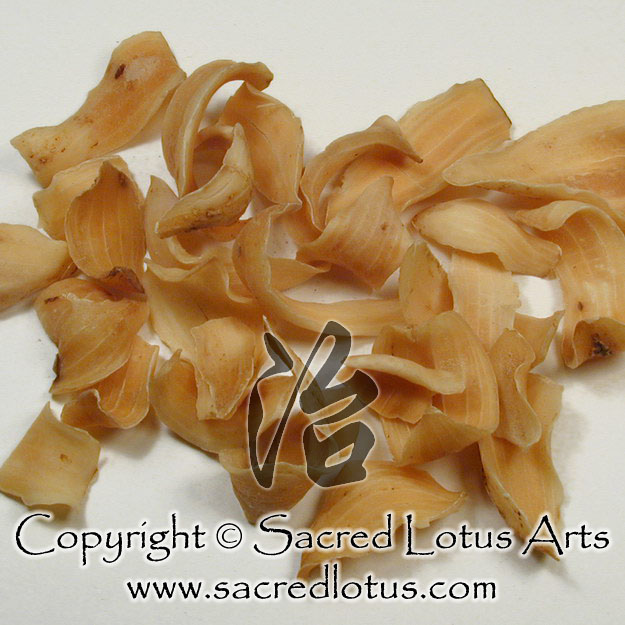
Materia Medica Data
- Category
- Herbs that Tonify Yin
- Temperature
- Slightly Cold
- Nature & Flavour
- Sweet, Slightly Bitter, Slightly Cold
- Channels Entered
- HT, LU
- Latin (pharmaceutical)
- Bulbus Lilii
- Chinese
- 百合
- Tone Marks
- băi hé
- Translation
- Hundred Meetings
Chinese Herb Actions
What is Bai He (lily bulb) used for in Chinese medicine?
Bai He moistens the Lung, clears heat, and calms the spirit (shen) — it is the principal herb for a dry, lingering cough from Lung yin/qi deficiency and for the restless, unsettled mental-emotional state historically named after it, “Bai He disease.”
Its main traditional actions:
- Moistens the Lung and stops cough — Lung qi-and-yin deficiency with a dry, chronic (“consumptive”) cough, shortness of breath, and scant or blood-streaked sputum that is hard to expectorate, often with night sweats and low-grade (tidal) fever.
- Clears heat and calms the spirit — the classical picture of disturbed mood and cognition, restlessness, a bitter taste in the mouth, dark urine, and a slightly rapid, thin pulse (see Bai He disease, below).
- Nourishes yin and harmonizes the Stomach — a dull, nagging Stomach-yin-deficiency type pain.
Bai He is also widely used as a food (in congee and soups) as well as a medicinal, reflecting its gentle, nourishing character.
Source: cross-referenced against multiple online sources (materia medica consensus); Sacred Lotus sources & references (category, channels, existing indications).
Chinese Herb Dosage
What is the typical dosage of Bai He (lily bulb)?
Roughly 10–30 g decocted, using the fleshy bulb scales. It is also eaten as a food — dried or fresh Bai He is common in congee and soups — and food-style preparations are typically gentler than a concentrated medicinal decoction.
Source: cross-referenced against multiple online sources (materia medica consensus); Sacred Lotus sources & references. Reference only — not a prescription.
Chinese Herb Combinations:
- Bai He (Bulbus Lilii)
- Zhi Mu (Rhizoma Anemarrhenae Aspheloidis)
Combined Actions:
- Nourish Yin and Clear Heat
Combined Indications:
- Mental agitation, insomnia, vertigo
- Dry cough
Preparation:
- Honey fry Bai He for dry cough and use raw Bai He for agitation and insomnia.
Chinese Herb Contraindications & Cautions
Are there cautions for Bai He (lily bulb)?
Bai He is moistening and cold, so it is avoided in cold-type (Wind-Cold) cough, phlegm-cough, or in patients with Middle-Jiao (Spleen/Stomach) deficiency, diarrhea, or loose stools, where its cooling, moistening nature could aggravate digestion.
- Sedative effect (reference note) — Bai He may cause mild sedation or drowsiness in some individuals; caution is reasonable around driving or operating machinery.
Source: cross-referenced against multiple online sources (materia medica consensus).
Western / Biomedical Research
Chinese Herb Clinical Studies & Research
Provided as research context — a summary of published biomedical study, not a therapeutic or medical claim.
Is there modern research on Bai He (Lilium)?
Yes — mostly preclinical (cell and animal) research on lily bulb extracts and polysaccharides, including one animal study directly modeling the classical Bai He Di Huang formula for mood-related symptoms.
- Bai He Di Huang Tang, depression model (preclinical) — a 2022 study combining metabolomics and network pharmacology found that lily bulb-and-Rehmannia decoction reduced depression-like behavior in a lipopolysaccharide-induced rat model, increasing serotonin and GABA while lowering inflammatory markers (IL-1β, IL-6, TNF-α) — a modern mechanistic echo of the classical use of this pairing for the restless, low-mood Bai He-disease picture. Animal model, not clinical proof.
- Mood/behavior (preclinical) — an aqueous lily bulb extract improved anxiety-like, depressive-like, and cognitive measures in ovariectomized mice, working through brain (hippocampal nerve-growth-factor and estrogen-receptor) pathways distinct from estrogen therapy itself.
- Polysaccharide pharmacology (preclinical review) — a 2024 review of Lilii Bulbus polysaccharides catalogs anti-inflammatory, antioxidant, and immunomodulatory activity, while noting the precise mechanisms still need further research.
Human clinical trials specific to Bai He were not identified; current support is preclinical (cell/animal) and classical/historical.
Sources: PMID 36205539 (lily bulb and Rehmannia decoction, LPS-induced depression rat model, Pharmaceutical Biology 2022); PMID 31207575 (lily bulb extract, ovariectomized mouse model, Biomedicine & Pharmacotherapy 2019); PMID 38888241 (Lilii Bulbus polysaccharide review, Journal of Pharmacy and Pharmacology 2024). Research context, not a therapeutic claim.
Chinese Herb Notes
What is “Bai He disease” and how is it treated?
Bai He disease (百合病, bǎi hé bìng) is a distinctive syndrome named after this herb in the Jin Gui Yao Lue (Essential Prescriptions of the Golden Cabinet, chapter 3), describing a person who wants to eat but cannot, wants to walk but cannot, wants to lie down but cannot, feels hot without fever and cold without chills, has a bitter taste in the mouth and dark urine, and seems outwardly well while feeling unsettled “as if possessed by a spirit,” with a slightly rapid pulse — classically following a febrile illness or emotional strain. It is often read today as a restless, somatic mood disturbance.
Classical Bai He formulas from the same chapter (traditional/historical context, not treatment advice):
- Bai He Zhi Mu Tang — Bai He with Zhi Mu, for the syndrome after incorrect sweating therapy.
- Bai He Ji Zi Huang Tang — Bai He with egg yolk, for the syndrome after incorrect vomiting therapy.
- Bai He Di Huang Tang — Bai He with fresh Rehmannia (Sheng Di Huang) juice, the best-known formula for the unresolved/underlying syndrome; see research below for a modern animal-model study of this pairing.
In the Sacred Lotus formula library, Bai He also anchors Bai He Gu Jin Tang (“Lily Bulb Decoction to Preserve the Metal”) — a later, different formula (with Sheng Di Huang, Shu Di Huang, Mai Men Dong, Xuan Shen, Chuan Bei Mu, Jie Geng, Dang Gui, Bai Shao, and Gan Cao) for Lung-and-Kidney-yin-deficiency chronic cough, distinct from the Jin Gui Yao Lue Bai He-disease formulas above.
Source: cross-referenced against multiple online sources (classical text summaries of the Jin Gui Yao Lue; materia medica consensus); Sacred Lotus sources & references (formula-herb linkage).
Sources & References
Compiled and edited by Thomas Dehli, Founder & Editor, Sacred Lotus Updated
The information here is referenced from numerous sources — teachers, practitioners, class notes from Five Branches University, the books below, and the published research literature, with citations given as resolvable PubMed identifiers. Where sources disagree, I have flagged the discrepancies directly. If facts couldn't be verified, I have left them out. How we source our content.
Reference information for students and practitioners — not medical advice. Consult a qualified practitioner. Terms of use.
Chinese Herbs Books & References
 https://amzn.to/3WfB3DK
 https://amzn.to/3DR1VUh
 https://amzn.to/42aMz73
 https://amzn.to/3PuD4bt