
Carapax Amydae Sinensis Chinese Soft Shelled Turtle Shell
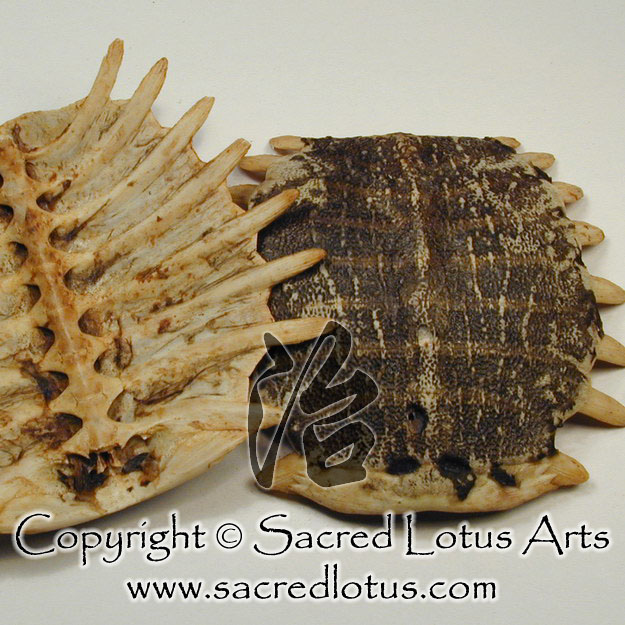
Materia Medica Data
- Category
- Herbs that Tonify Yin
- Temperature
- Cold
- Nature & Flavour
- Salty, Cold
- Channels Entered
- LIV, SP
- Latin (pharmaceutical)
- Carapax Amydae Sinensis
- Chinese
- 鳖甲
- Tone Marks
- biē jiă
Chinese Herb Actions
What is Bie Jia used for in Chinese medicine?
Bie Jia is the dried carapace (upper shell) of the Chinese soft-shelled turtle, used traditionally to nourish yin, anchor rising yang, clear heat that arises from yin deficiency, and soften hard masses and nodules. It is salty and cold, entering the Liver and Spleen channels, and sits in the yin-tonifying category alongside Gui Ban.
Its main traditional actions:
- Nourishes yin and anchors rising yang — yin-deficiency patterns with heat signs: tidal fever, night sweats, five-centre heat, dizziness and irritability where yang floats upward for lack of yin to hold it.
- Clears deficiency heat and “steaming bone” fever — the classic low-grade, deep, afternoon-or-night fever of chronic yin depletion. This is the action behind its place in Qing Gu San (Cool the Bones Powder).
- Vents heat lingering in the yin level of a late-stage febrile disease — fever that abates in the morning and returns at night without sweating, the pattern addressed by Qing Hao Bie Jia Tang (Artemisia Annua and Soft-Shelled Turtle Shell Decoction).
- Softens hardness and dissipates nodules and masses — palpable abdominal masses, glandular swellings, and the enlarged spleen classically associated with chronic intermittent fevers; also amenorrhoea attributed to long-standing blood stasis. Vinegar-processing is traditionally used to emphasise this action.
- Supports the shell-and-mineral strategy of “anchoring” internal wind — as one of the heavy, yin-rich substances in San Jia Fu Mai Tang (Three Shell Decoction to Restore the Pulse) and Da Ding Feng Zhu (Major Arrest Wind Pearl), where yin depletion allows tremor and internal wind to stir.
Source: Sacred Lotus identity record (Salty, Cold; Liver and Spleen channels; Herbs that Tonify Yin) and its own formula links; standard materia medica consensus (Bensky, Chinese Herbal Medicine: Materia Medica, 3rd ed.; Chen & Chen, Chinese Medical Herbology and Pharmacology), cross-referenced against multiple online sources. Traditional-use framing; not medical advice.
Chinese Herb Dosage
What is the typical dosage of Bie Jia?
10–30 g in decoction is the range carried in the Sacred Lotus reference record, which sits within the usual published materia medica range for shell medicinals. Because it is a dense, hard animal shell, it is conventionally crushed or broken and decocted first (added ahead of the other ingredients, commonly 30–60 minutes) so that its constituents can be extracted.
- Preparation matters as much as the dose. Raw Bie Jia is used when the intent is to nourish yin and clear deficiency heat; vinegar-processed Bie Jia (cu bie jia) is the form traditionally chosen when the intent is to soften nodules and masses.
- Powdered or granulated extracts are dosed far lower than raw shell — follow the manufacturer’s stated equivalence rather than converting from the decoction range.
Source: Sacred Lotus dosage record (10–30 grams); preparation conventions for shell medicinals per Bensky (3rd ed.) and Chen & Chen, cross-referenced against multiple online sources. Reference only — not a prescription.
Chinese Herb Contraindications & Cautions
Are there cautions for Bie Jia?
Bie Jia is contraindicated in pregnancy in our reference record, and is not suited to Spleen deficiency with loose stools or diarrhoea, or to cases where an exterior pattern is still present. It is a cold, heavy, downward-moving shell, so it burdens weak digestion and is the wrong tool while a surface pattern still needs releasing.
- Pregnancy — contraindicated. Its blood-moving, mass-softening character is the traditional reason.
- Spleen deficiency with loose stool or diarrhoea — avoid; cold and heavy substances aggravate this picture.
- Exterior disorder present — avoid; yin-enriching substances can trap a pathogen that still needs to be released.
- Animal-derived (dietary/ethical reference note) — Bie Jia is turtle shell and is not suitable for vegetarians or vegans. Formulas containing it should be disclosed on that basis.
- Sourcing and species identity (reference note) — Chinese soft-shelled turtles are farmed at large scale, but wild populations of the species are documented as rapidly declining under habitat loss, over-harvesting and pollution, and international trade controls for turtles differ from species to species. Shell material can be substituted between turtle species, so verified provenance and species identity matter for both legality and label accuracy.
Source: Sacred Lotus cautions record (pregnancy; Spleen deficiency with loose stool; exterior disorder present); wild-population status per PMID 39830702 / DOI 10.1002/ece3.70789. Animal-source, sourcing and substitution points are neutral reference disclosures, not usage instructions.
Chinese Herb Toxicity & Overdose
Is Bie Jia toxic?
Bie Jia is not classified as a toxic herb, and our reference record does not flag it as toxic or endangered. It is a collagen-rich animal shell with a long dietary and medicinal history in China; published materia medica sources report no significant intrinsic toxicity at customary doses. The realistic concerns are not poisoning but quality: correct species, clean processing, and the digestive burden of a cold, heavy substance in weak patients.
- Allergen consideration — it is an animal collagen/protein material, relevant to anyone with known sensitivity to gelatin or shellfish-adjacent animal products.
- Contaminant consideration — as with any farmed aquatic animal product, heavy-metal and veterinary-residue testing is a legitimate quality question to put to a supplier.
Source: Sacred Lotus record (not flagged toxic/endangered); materia medica consensus (Bensky 3rd ed.; Chen & Chen), cross-referenced against multiple online sources. Reference note, not a safety guarantee.
Herb-Drug Interactions
Does Bie Jia interact with medications?
No well-established clinical herb–drug interactions are documented for Bie Jia. Formal interaction studies are essentially absent, so the honest answer is that this is under-researched rather than proven safe. Anyone taking prescription medication — particularly people with liver disease, since much of the modern research on this material concerns liver fibrosis — should have herbal use reviewed by a qualified practitioner alongside their physician. (Precautionary; no demonstrated clinical interaction.)
Western / Biomedical Research
Chinese Herb Clinical Studies & Research
Provided as research context — a summary of published biomedical study, not a therapeutic or medical claim.
Is there modern research on Bie Jia (turtle shell, Pelodiscus sinensis)?
Yes — the research base is preclinical and concentrates almost entirely on liver fibrosis, matching the traditional “softens hardness” use. Turtle-shell protein hydrolysates and short peptides have repeatedly been reported to suppress hepatic stellate cell activation through TGF-β1 signalling in cell and rodent models. There are no adequate human clinical trials, so none of this establishes clinical effect.
- Peptides and hepatic stellate cells — a peptide preparation from Carapax Trionycis reduced collagen I, collagen III, TIMP-1 and α-SMA and lowered phosphorylated Smad3 in TGF-β1-stimulated hepatic stellate cells, consistent with interference in the TGF-β1/Smad pathway (cell culture).
- Peptide screening — two-enzyme hydrolysis of turtle-shell protein followed by molecular docking identified peptides (for example GPPGVPGPGPL) with anti-fibrotic activity in vitro, supporting the idea that the active fraction is peptidic rather than mineral.
- Whole-decoction animal model — a turtle-shell decoction improved liver enzymes and reduced fibrosis in carbon-tetrachloride-treated rats while downregulating TGF-β1 and Smad3 and upregulating inhibitory Smad7 (rat model).
- Synthesised peptides — chemically synthesised Carapax Trionycis peptides showed inhibitory effects on TGF-β1-induced hepatic stellate cells, and a related oligo-peptide ameliorated CCl4-induced liver fibrosis in mice via NF-κB and Wnt/β-catenin suppression (preclinical).
- Material chemistry — acid- and pepsin-soluble collagens have been characterised from the carapace tissue of Pelodiscus sinensis, confirming collagen as the dominant structural protein of the shell.
- Conservation context — field research on the species describes wild populations as rapidly declining and threatened by habitat destruction, overfishing and water pollution, which is the factual basis for treating provenance as a real question rather than a formality.
Human clinical evidence is absent; everything above is laboratory or animal work and is presented as scientific context, not as a therapeutic claim.
Sources: PMID 23583903, DOI 10.1016/j.jep.2013.03.067 (Carapax Trionycis peptide, hepatic stellate cells); PMID 36648420, DOI 10.1039/d2fo03307k (anti-liver-fibrosis peptide screening); PMID 27633729, DOI 10.3892/or.2016.5078 (turtle shell decoction, rat model); PMID 24423656, DOI 10.5582/ddt.2013.v7.6.248 (synthesised peptides); PMID 29501581, DOI 10.1016/j.jphs.2018.01.003 (oligo-peptide, CCl4 mouse model); PMID 32835948 (carapace collagen characterisation); PMID 39830702, DOI 10.1002/ece3.70789 (wild population status). Research context, not a therapeutic claim.
Chinese Herb Notes
What is the difference between Bie Jia and Gui Ban?
Both are yin-tonifying shells that are salty and cold, but they come from different animals and are emphasised differently: Bie Jia is the carapace (upper shell) of the soft-shelled turtle and leans toward clearing deficiency heat and softening masses, while Gui Ban is the plastron (lower shell) of a freshwater tortoise/turtle and leans toward nourishing Kidney yin, benefiting the bones, and nourishing blood. This pair is a standard exam comparison, so the distinctions below are worth holding precisely.
- Part and animal — Bie Jia: carapace, soft-shelled turtle. Gui Ban: plastron, hard-shelled freshwater turtle/tortoise. The Sacred Lotus records give the pharmaceutical names as Carapax Amydae Sinensis and Plastrum Testudinis respectively.
- Flavour — Bie Jia is recorded as Salty, Cold; Gui Ban as Salty, Sweet, Cold. The added sweetness of Gui Ban tracks its stronger tonifying and blood-nourishing character.
- Channels — Bie Jia: Liver, Spleen. Gui Ban: Heart, Kidney, Liver. Gui Ban’s Kidney and Heart entry underlies its use for bone weakness, developmental delay, and yin-deficiency palpitations and insomnia.
- Emphasis — Bie Jia is the stronger choice for clearing heat from deficiency and for softening hardness / dissipating nodules and abdominal masses. Gui Ban is the stronger choice for nourishing Kidney yin and strengthening the sinews and bones, and for nourishing blood and stabilising the Chong and Ren in deficiency-type uterine bleeding.
- Formula company — both appear together in San Jia Fu Mai Tang and Da Ding Feng Zhu, where the shells supply heavy, yin-rich weight. Bie Jia alone characterises Qing Hao Bie Jia Tang and Qing Gu San; Gui Ban alone characterises Da Bu Yin Wan, Hu Qian Wan, Gu Jing Wan and Zhen Gan Xi Feng Tang.
Memory hook: Bie Jia works on what is hot and hard (deficiency fever, masses); Gui Ban works on what is empty and unsupported (Kidney yin, bones, blood).
Naming note: our reference record gives the pharmaceutical Latin as “Carapax Amydae Sinensis.” Amyda sinensis is a historical synonym; the currently accepted zoological name for the Chinese soft-shelled turtle is Pelodiscus sinensis, and modern pharmacopoeial and research literature usually writes the material as Carapax Trionycis / Trionycis Carapax. We believe these all refer to the same substance; the identity field is left unchanged pending owner confirmation.
Source: Sacred Lotus identity and formula records for Bie Jia and Gui Ban; differentiation per standard materia medica consensus (Bensky 3rd ed.; Chen & Chen), cross-referenced against multiple online sources.
Sources & References
Compiled and edited by Thomas Dehli, Founder & Editor, Sacred Lotus Updated
The information here is referenced from numerous sources — teachers, practitioners, class notes from Five Branches University, the books below, and the published research literature, with citations given as resolvable PubMed identifiers. Where sources disagree, I have flagged the discrepancies directly. If facts couldn't be verified, I have left them out. How we source our content.
Reference information for students and practitioners — not medical advice. Consult a qualified practitioner. Terms of use.
Chinese Herbs Books & References
 https://amzn.to/3WfB3DK
 https://amzn.to/3DR1VUh
 https://amzn.to/42aMz73
 https://amzn.to/3PuD4bt