

Ye Ming Sha (Bat Feces)
Excrementum Vespertilionis Murini Bat Feces
Materia Medica Data
- Category
- Herbs that Drain Fire
- Temperature
- Cool
- Nature & Flavour
- Spicy, Cool
- Channels Entered
- LIV
- Latin (pharmaceutical)
- Excrementum Vespertilionis Murini
- Chinese
- 夜明砂
- Tone Marks
- yè míng shā
- Translation
- Night Brightness Sand
Chinese Herb Actions
What is Ye Ming Sha (夜明砂, bat faeces) used for in Chinese medicine?
Ye Ming Sha is traditionally used to clear heat from the Liver channel and to improve vision — classically for night blindness, cataracts and superficial visual obstruction — and secondarily for childhood malnutrition. Its name translates as “night brightness sand,” a direct reference to the night-vision indication. It is a minor, narrow-use item rather than a common clinical herb.
Its recorded traditional actions:
- Clears heat in the Liver channel and brightens the eyes — the principal use, for night blindness, cataract and superficial obstruction of vision. In classical theory the Liver opens into the eyes, which is why an eye herb sits in the Liver channel.
- Treats childhood malnutrition — the gan-ji pattern of chronic under-nutrition and failure to thrive in children, often associated with intestinal parasites.
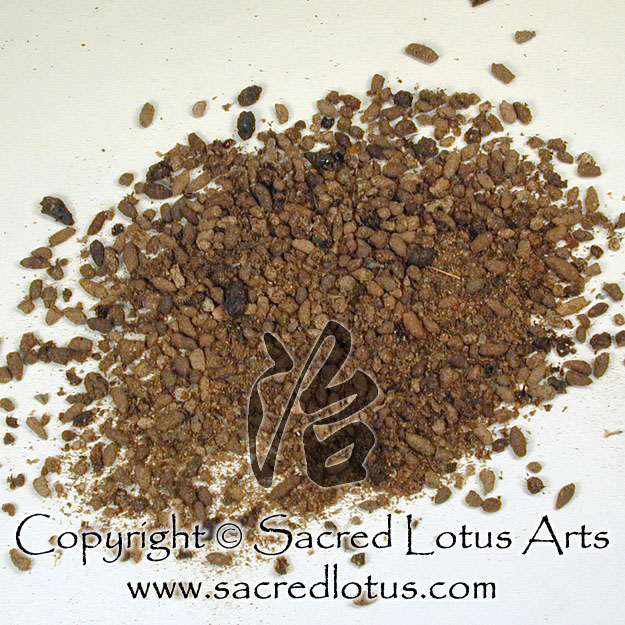
Its traditional profile on this site is spicy and cool, entering the Liver channel, classified among the herbs that drain fire. The material itself is the dried droppings of insectivorous bats, and its visible content of undigested insect fragments is the feature that gave it its granular, sand-like appearance and its name.
Sources: our own site identity record for Ye Ming Sha (Excrementum Vespertilionis Murini; spicy, cool; Liver channel; drain-fire category; recorded translation “Night Brightness Sand”), cross-referenced against multiple online sources for the classical description. Traditional-use framing; not a medical claim.
Chinese Herb Dosage
What is the typical dosage of Ye Ming Sha?
Our records give 3–9 grams, in line with standard materia medica ranges for this item. Because it is a gritty, insoluble mineral-and-insect residue rather than a plant tissue, it is conventionally wrapped for decoction or given in powder or pill form; our own formula record for Bu Dai Wan lists it in a pill, not in a bulk decoction.
This figure is reference information only, not a prescription. Ye Ming Sha is a narrow-indication herb used within a pattern diagnosis, and any use belongs with a qualified practitioner working from raw material of verified quality — see the cautions and safety sections below, which are the more important part of this entry.
Sources: our own site dosage record (3–9 g) and formula record for Bu Dai Wan (pill preparation); standard materia medica ranges, cross-referenced against multiple online sources. Reference only — not a prescription.
Chinese Herb Contraindications & Cautions
Are there cautions for Ye Ming Sha, and is it safe?
Our records give two traditional cautions — it is contraindicated in pregnancy, and traditional sources state it is not to be combined with Bai Wei — and there is one substantial modern concern, which is the handling of bat guano rather than the finished herb. Bat droppings accumulating in caves and roosts are the classic environmental source of Histoplasma, the fungus that causes histoplasmosis.
- Pregnancy. Contraindicated during pregnancy, per our own records and standard materia medica caution.
- Traditional incompatibility. Traditional sources record that it should not be used with Bai Wei (swallowwort root). Our caution text names this as “Radix Cynanchi Baiwei” while our own Bai Wei entry gives the pharmaceutical Latin as Radix Cynanchi Atrati; we take these to refer to the same herb and have flagged the naming inconsistency rather than altered either record.
- Histoplasmosis is the real, documented occupational risk. Histoplasma grows in soil enriched by bat and bird droppings, and disturbing that material aerosolises infectious spores. A systematic review of 814 acute histoplasmosis cases in immunocompetent travellers found cave exploration and/or contact with bat guano to be the exposure route in 60.9% of cases, and identified that exposure as associated with progression to disseminated disease. The risk therefore attaches to collecting, drying and handling raw guano — not to a patient taking a processed pill.
- Bats also carry viruses. Bats are established reservoir hosts for several virus families, including coronaviruses, filoviruses, henipaviruses and rotaviruses, with documented cross-species transmission. This is a reason for caution around raw bat material and roost environments generally. We do not attribute any specific human outbreak to this herb, and we note that the strength of reservoir evidence varies considerably between studies and regions.
- Identity and quality cannot be assumed. There is no published authentication method for this material, so species of origin, contamination and microbiological quality are all unverified in commerce.
Sources: our own site caution record (pregnancy; incompatibility with Bai Wei); PMID 30563472, PMC 6299618, DOI 10.1186/s12879-018-3476-z (814 cases; caves and/or bat guano contact in 60.9%; association with disseminated disease); PMID 37553137, PMC 10802898, DOI 10.1093/mmy/myad080 (Histoplasma in bats and in guano-admixed soil); PMID 35679864, PMC 9148931, DOI 10.1016/j.celrep.2022.110969 (cross-species transmission of coronaviruses, filoviruses, henipaviruses and rotaviruses from bats); PMID 37964576, PMC 10646460, DOI 10.1098/rsbl.2023.0358 (limits of the reservoir-host evidence base). Neutral reference facts; not medical advice.
Chinese Herb Toxicity & Overdose
Is Ye Ming Sha toxic, and what is the histoplasmosis risk?
Ye Ming Sha is not classified as a toxic herb in the traditional literature, and our records note no toxicity. The documented hazard is infectious rather than toxicological, and it concerns the raw material and the roost environment. Histoplasma species grow in soil enriched with bat guano; the spores become airborne when the deposit is disturbed, and inhaling them causes histoplasmosis — a fungal infection that can range from a self-limiting flu-like illness to severe pulmonary or disseminated disease.
- The association is well established. A systematic review of 814 acute histoplasmosis cases in immunocompetent travellers identified cave exploration and/or bat-guano contact as the exposure in 60.9% of cases — and immunocompetence is no guarantee of a mild course, since that same exposure category was associated with disseminated disease.
- It is not confined to the Americas. Although histoplasmosis is most endemic in the American continent, Histoplasma has been detected molecularly in bats and cave environments in South Africa, Brazil and Portugal, and reviews now describe the genus as globally distributed with bats as a recurring feature of its ecology.
- Who is most at risk. Immunocompromised people are at greatest risk of severe and disseminated disease, and infection can involve the lungs, adrenal glands, gut and multiple organ systems.
- What this means practically. The hazard sits with anyone who would gather or handle raw guano. Nothing on this page should be read as instruction to collect this material, and we give none.
Sources: our own site record (no toxicity noted traditionally); PMID 30563472, PMC 6299618, DOI 10.1186/s12879-018-3476-z; PMID 37553137, PMC 10802898, DOI 10.1093/mmy/myad080; PMID 41428709, PMC 12755807, DOI 10.1371/journal.pntd.0013778 (Histoplasma capsulatum detected in South African cave environments); PMID 40793772, PMC 12442369, DOI 10.1128/aem.00335-25 (Histoplasma mapped in bats and cave ecosystems, midwestern Brazil); PMID 40005854, PMC 11861867, DOI 10.3390/vetsci12020094 (Histoplasma capsulatum in bat species in Portugal). Neutral reference facts; not medical advice.
Western / Biomedical Research
Chinese Herb Clinical Studies & Research
Provided as research context — a summary of published biomedical study, not a therapeutic or medical claim.
Is there modern research on Ye Ming Sha (Excrementum Vespertilionis Murini)?
No — searches of PubMed and PMC return no pharmacological, chemical or clinical studies of bat faeces as a medicinal material. We state that directly rather than pad the section: there is no efficacy or constituent literature to summarise for this herb, and the traditional indications rest on classical materia medica consensus alone.
The modern literature that is relevant sits around the animal rather than the medicine:
- Histoplasmosis ecology and epidemiology — the systematic review of acute histoplasmosis in immunocompetent travellers, a narrative review of Histoplasma infection in bats and in guano-admixed soil covering 49 bat species, and recent molecular surveys detecting Histoplasma in caves and bat populations in South Africa, Brazil and Portugal.
- Bats as viral reservoirs — work on cross-species transmission of coronaviruses, filoviruses, henipaviruses and rotaviruses from bats, balanced by a 2023 review arguing that robust evidence for reservoir status is in fact lacking in most African virus studies, and calling for stricter criteria. Both are worth holding together: bats genuinely matter for zoonotic disease, and individual reservoir claims are often weaker than headlines suggest.
- The condition behind the classical indication — night blindness is documented in the modern clinical literature as a manifestation of vitamin A deficiency, with Bitot’s spots and dry eye, reversible on repletion.
The honest summary is that this remains a traditional-consensus herb with no research base of its own, and that what is well documented about bats is a reason for care in handling rather than evidence of benefit.
Sources: PubMed and PMC searches for this material returned no pharmacological studies (searched 2026); PMID 30563472, PMC 6299618, DOI 10.1186/s12879-018-3476-z; PMID 37553137, PMC 10802898, DOI 10.1093/mmy/myad080; PMID 41428709, PMC 12755807, DOI 10.1371/journal.pntd.0013778; PMID 40793772, PMC 12442369, DOI 10.1128/aem.00335-25; PMID 40005854, PMC 11861867, DOI 10.3390/vetsci12020094; PMID 35679864, PMC 9148931, DOI 10.1016/j.celrep.2022.110969; PMID 37964576, PMC 10646460, DOI 10.1098/rsbl.2023.0358; PMID 33453784, DOI 10.1016/S0140-6736(21)00041-6; PMID 30265370, DOI 10.1093/qjmed/hcy218. Research context, not a therapeutic claim.
Chinese Herb Notes
Which formula contains Ye Ming Sha, and how does it fit the classical eye-herb group?
One formula in our records carries it: Bu Dai Wan (“Cloth Sack Pill”), a paediatric formula for malnutrition from parasites — the gan-ji pattern. There, Ye Ming Sha sits alongside the anthelmintic and purgative components Shi Jun Zi, Lu Hui and Wu Yi, on top of a Si Jun Zi Tang base of Ren Shen, Bai Zhu, Fu Ling and Gan Cao that protects the child’s already-weak digestion. Our formula record presents that entry as documented classical paediatric content and historical reference, not as guidance for treating a child today.
- Where it sits among the eye herbs — classical practice grouped several very different substances under “brightens the eyes”: cooling seeds and flowers such as Ju Hua and Jue Ming Zi for Liver heat rising to the eyes, blood-and-yin nourishers such as Gou Qi Zi for eyes deprived of nourishment, and heavy shells such as Shi Jue Ming (“stone decide brightness”) for ascendant Liver yang. Ye Ming Sha belongs with the heat-clearing group and is distinguished by its specific classical association with poor night vision.
- The night-blindness link, stated carefully. Night blindness in modern medicine is most commonly a manifestation of vitamin A deficiency, alongside signs such as Bitot’s spots and dry eye, and it responds to vitamin A repletion. We note this because it is the modern diagnosis behind the classical presentation — not as a claim that this herb supplies vitamin A, which we could not verify to any resolvable source and therefore do not assert.
Sources: our own formula record for Bu Dai Wan (composition, pattern, historical framing) and our own herb identity records for the comparison herbs; PMID 33453784, DOI 10.1016/S0140-6736(21)00041-6 and PMID 30265370, DOI 10.1093/qjmed/hcy218 (night blindness and Bitot’s spots as manifestations of vitamin A deficiency); classical eye-herb groupings cross-referenced against multiple online sources. Traditional-use framing; not a medical claim.
Sources & References
Compiled and edited by Thomas Dehli, Founder & Editor, Sacred Lotus Updated
The information here is referenced from numerous sources — teachers, practitioners, class notes from Five Branches University, the books below, and the published research literature, with citations given as resolvable PubMed identifiers. Where sources disagree, I have flagged the discrepancies directly. If facts couldn't be verified, I have left them out. How we source our content.
Reference information for students and practitioners — not medical advice. Consult a qualified practitioner. Terms of use.
Chinese Herbs Books & References
 https://amzn.to/3WfB3DK
 https://amzn.to/3DR1VUh
 https://amzn.to/42aMz73
 https://amzn.to/3PuD4bt