

Shi Wei (Pyrrosia Leaves)
Herba Pyrrosiae Pyrrosia Leaves
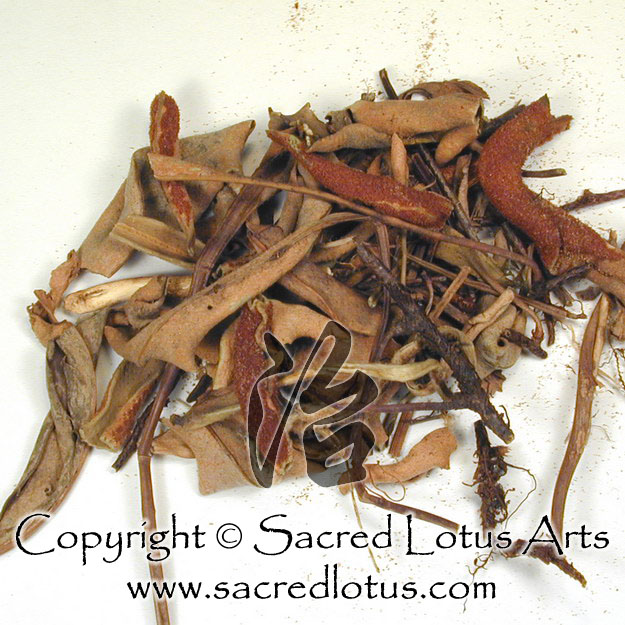
Materia Medica Data
- Temperature
- Slightly Cold
- Nature & Flavour
- Bitter, Sweet, Slightly Cold
- Channels Entered
- BL, LU
- Latin (pharmaceutical)
- Herba Pyrrosiae
- Chinese
- 石苇
- Tone Marks
- shí wĕi
- Translation
- Stone Reed
Chinese Herb Actions
What is Shi Wei used for in Chinese medicine?
Shi Wei is a bitter, sweet, slightly cold herb used above all for hot, painful, difficult urination — the lin syndromes, including stone lin and blood lin. It is classified with the herbs that regulate water and drain dampness, and it is one of the few herbs in that group that also stops bleeding and works on the Lungs.
Its traditional actions, per our record:
- Clears damp-heat, promotes urination and reduces oedema — burning, painful urination with or without stones, blood or dribbling, attributed to damp-heat; also used to reduce oedema.
- Stops bleeding — blood in the urine, and also trauma, vomiting of blood, nosebleed and excessive menstrual bleeding. This is unusual for a damp-draining herb and is part of why it is chosen for blood lin specifically.
- Stops cough, expels phlegm and clears the Lungs — cough and wheezing from Lung heat with phlegm.
- Enters the Bladder and Lung channels — our record's own note explains the logic well: because it reaches both the Lung and the Bladder, it can clear damp and heat from the upper and the lower parts of the body, which is the water-metabolism relationship between the two organs (the “upper source of water”).
The medicinal part is the leaf of an epiphytic fern that grows on rocks and tree trunks — the name means “stone” plus the plant name, a reference to where it grows.
Source: our own herb record (category, nature and flavour, channels, indications, and the Lung–Bladder note), cross-referenced against multiple online sources and published materia medica consensus. Traditional-use framing; not medical advice.
Chinese Herb Dosage
What is the typical dosage of Shi Wei?
Our record carries two cited ranges: 5–10 g in decoction, rising to 15–30 g in severe cases, and 6–9 g in decoction from a second reference. These overlap closely; the practical reading is a standard dose of roughly 6–10 g, with a higher ceiling reserved for acute or severe presentations under professional care.
- Decoction, standard — 5–10 g (one of our cited references gives 6–9 g).
- Decoction, severe cases — 15–30 g, per the first of our cited references.
- Part used — the leaf (frond), with the brown scurfy hairs on the underside traditionally brushed off before use.
Source: our own herb record dosage entries and their cited references, cross-referenced against multiple online sources. Reference only — not a prescription.
Chinese Herb Contraindications & Cautions
Are there cautions for Shi Wei?
Our record states “none noted” for both cautions and toxicity, and Shi Wei is generally regarded as a mild, well-tolerated herb. That is not the same as “no considerations at all” — the sensible reference cautions follow from what the herb does rather than from reported harm.
- Yin deficiency without damp-heat — this is a draining, urine-promoting herb; where there is no dampness to drain and fluids are already depleted, it is not indicated.
- Cold from deficiency in the lower burner — its slightly cold nature makes it a poor fit for a cold, deficient urinary picture.
- Pregnancy — no specific contraindication is recorded here; as with any diuretic herb, professional supervision applies.
- Urinary blood or stones — blood in the urine and suspected urinary stones are presentations that warrant medical assessment. This is a reference note about the symptom, not about the herb.
- Correct species — three official species and several look-alikes exist (see notes); correctly identified material matters.
Source: our own herb record caution and toxicity entries (both “none noted”); category-level considerations cross-referenced against multiple online sources. Reference information, not medical advice.
Chinese Herb Toxicity & Overdose
- None Noted
Herb-Drug Interactions
- None Noted
Western / Biomedical Research
Chinese Herb Clinical Studies & Research
Provided as research context — a summary of published biomedical study, not a therapeutic or medical claim.
Is there modern research on Shi Wei (Pyrrosia leaves)?
Yes — a modest but coherent preclinical literature that lines up with the traditional urinary indications: diuresis, urinary stone models, and activity against urinary-tract bacteria. It is laboratory and animal work; there is no body of human clinical trial evidence for this herb, and nothing below is a treatment recommendation.
- Diuretic effect and mechanism — Pyrrosia petiolosa has been investigated as a lower-toxicity route to inhibiting the sodium–chloride cotransporter, the target of thiazide diuretics, in an animal diuretic model. Separate work has characterised the pharmacokinetics and metabolomic mechanism of barbatic acid from the same species in relation to its diuretic effect.
- Urinary stone models — network pharmacology combined with in vivo verification has examined the molecular mechanism of Pyrrosia lingua in nephrolithiasis. Animal and computational work only. (One earlier animal study of a Pyrrosia extract in an ethylene-glycol urolithiasis model has since been retracted and is deliberately not cited here.)
- Urinary-tract bacteria — caffeoylquinic acid compounds from Pyrrosia lingua have been reported to act synergistically with levofloxacin against uropathogenic Escherichia coli, including antibiofilm effects, supported by molecular dynamics simulation. In vitro.
- Chemistry — the constituents of Pyrrosia petiolosa were characterised in a study already cited in our record; flavonoid content and antioxidant activity have since been shown to vary substantially with geographic origin, which is a quality-control point as much as a pharmacological one.
- Other directions — hypoglycaemic mechanisms of chlorogenic acids from P. petiolosa, effects on bone loss in ovariectomised mice, and protection against radiation-induced intestinal injury in animals. All early-stage.
The pattern is consistent: this fern's chemistry (flavonoids, chlorogenic and caffeoylquinic acids, barbatic acid) supports diuretic, antioxidant and antibacterial activity in the laboratory, which is a plausible correlate of the traditional lin-syndrome use — but correlation in a rodent or a Petri dish is not clinical evidence.
Sources: PMID 37422255, DOI 10.1016/j.pharma.2023.07.002 (Na–Cl cotransporter inhibition and diuretic mechanism, P. petiolosa); PMID 41972524, PMC 13072244, DOI 10.3390/biology15070521 (barbatic acid pharmacokinetics and diuretic mechanism); PMID 35104754, DOI 10.1016/j.phymed.2022.153929 (P. lingua in nephrolithiasis, network pharmacology plus in vivo); PMID 39683837, PMC 11643949, DOI 10.3390/molecules29235679 (caffeoylquinic acids with levofloxacin against uropathogenic E. coli); PMID 12765199, DOI 10.1080/1028602031000066843 (chemical constituents of P. petiolosa — the study already cited in our record); PMC 10140315, DOI 10.3389/fpls.2023.1173489 (flavonoid and antioxidant variation by geographic origin); PMID 38104881, DOI 10.1016/j.jep.2023.117580 (chlorogenic acids, hypoglycaemic mechanism); PMID 35033946, DOI 10.1016/j.biopha.2022.112640 (bone loss model); PMID 42352999, PMC 13300518 (radiation-induced intestinal injury model). Research context, not a therapeutic claim.
Chinese Herb Notes
Which plant does Shi Wei come from?
Three species, not one. Our record gives the Latin as Herba Pyrrosiae. Modern Chinese standards recognise three original plants for this drug — Pyrrosia sheareri, Pyrrosia lingua and Pyrrosia petiolosa — all ferns in the Polypodiaceae, all supplying leaf material sold under the same name. Because their leaves look alike and are easily confused with related species, researchers have sequenced the complete chloroplast genomes of all three and proposed DNA regions that can tell them apart.
- Pyrrosia sheareri — the largest-leaved of the three.
- Pyrrosia lingua — the species most often studied for urinary-stone models in the modern literature.
- Pyrrosia petiolosa — the smallest, and the species behind most of the modern diuretic and chemistry work.
Two naming notes. First, our record gives the Latin as Herba Pyrrosiae (“herb”), while the material used and the name in current standards is the leaf — Pyrrosiae Folium. Second, our record writes the Chinese as 石苇, while the herb is more usually written 石韦. Both point to the same medicinal; the identity fields are left unchanged pending owner confirmation.
What is Shi Wei combined with?
It is a supporting rather than a solo herb, and it is combined according to which aspect of lin syndrome dominates. Our own site does not currently link Shi Wei into a formula, so the pairings below are given as general practice context rather than as a formula composition.
- For stone lin — with Jin Qian Cao and Hai Jin Sha, the two herbs most associated with urinary stones.
- For hot lin — with Qu Mai, Bian Xu, Che Qian Zi and Hua Shi, the core damp-heat urinary group.
- For blood lin — with cooling, blood-stopping herbs such as Da Ji, playing to Shi Wei's own stop-bleeding action.
- For Lung heat cough — with phlegm-heat clearing herbs, using its second, upper-burner direction.
(Traditional practice context, not treatment advice.)
Source: our own herb record (Latin, Chinese, the Lung–Bladder note) and our own records for the herbs named; three original species and their identification per PMID 32768164, DOI 10.1016/S1875-5364(20)30069-8. Cross-referenced against multiple online sources.
Sources & References
Compiled and edited by Thomas Dehli, Founder & Editor, Sacred Lotus Updated
The information here is referenced from numerous sources — teachers, practitioners, class notes from Five Branches University, the books below, and the published research literature, with citations given as resolvable PubMed identifiers. Where sources disagree, I have flagged the discrepancies directly. If facts couldn't be verified, I have left them out. How we source our content.
Reference information for students and practitioners — not medical advice. Consult a qualified practitioner. Terms of use.
Chinese Herbs Books & References
 https://amzn.to/3WfB3DK
 https://amzn.to/3DR1VUh
 https://amzn.to/42aMz73
 https://amzn.to/3PuD4bt