

Luo Han Guo (Momordica Fruit)
Fructus Momordicae Grosvenori Momordica Fruit
Also known as La Han Guo, Jia Ku Gua
Materia Medica Data
- Category
- Herbs that Tonify Yin
- Temperature
- Cool
- Nature & Flavour
- Sweet, Cool (or Neutral)
- Channels Entered
- LU, LI (SP)
- Latin (pharmaceutical)
- Fructus Momordicae Grosvenori
- Chinese
- 罗汉果
- Tone Marks
- luó hàn guŏ
- Also Known As
- La Han Guo, Jia Ku Gua
- Translation
- Arhat Fruit
Chinese Herb Actions
What is Luo Han Guo used for in Chinese medicine?
Luo Han Guo is used to moisten the Lungs and stop a dry cough — the classic picture is a chronic, hot, unproductive cough with a dry throat, hoarseness or loss of voice, and scanty sputum that is difficult to bring up, sometimes blood-streaked. This reference records it as sweet and cool (or neutral), entering the Lung and Large Intestine channels (with the Spleen noted secondarily), and files it among the Herbs that Tonify Yin.
Its traditional actions, as carried in this reference's own record:
- Moistens the Lungs, clears heat and stops cough — for chronic dry hot cough and dry throat, with or without scanty, difficult, or blood-streaked yellow sputum. Sore throat and loss of voice belong to the same picture.
- Generates fluid to stop thirst — for thirst from depleted fluids.
- Moistens the intestines to unblock the bowels — for constipation of the dry type, where the stool is hard because the intestines lack moisture rather than because heat is accumulating.
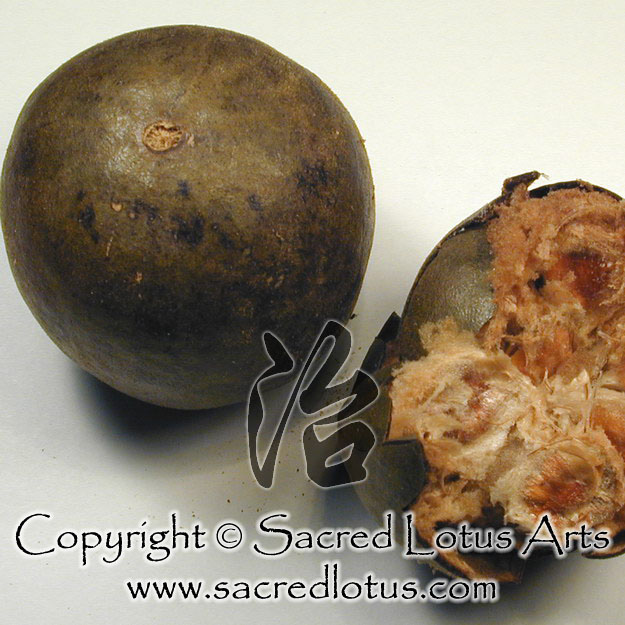
Part used: the dried ripe fruit — a round, brown, papery-shelled gourd about the size of a small apple, grown almost entirely in Guangxi in southern China. It is intensely sweet, which is unusual for a medicinal fruit and is central to what the herb is (see Research).
Source: this reference's own herb record (properties, channels, category, recorded actions); the same traditional indications — lung fire and dry cough, sore throat and loss of voice, intestinal dryness and constipation — are recorded in a comprehensive review of the species (PMID 38638866, PMC 11024725). Cross-referenced against multiple online sources and published materia medica consensus (Bensky, Materia Medica, 3rd ed.; Chen & Chen). Traditional-use framing; not medical advice.
Chinese Herb Dosage
What is the typical dosage of Luo Han Guo?
15–30 g in decoction, or 1–2 whole fruits, crushed — this reference's own recorded dosage, with a second reference in the collection giving 9–15 g. The wide spread is normal for this herb: it is a large, light, hollow fruit, so a "dose" is often counted in fruits rather than weighed.
- How it is actually prepared — the shell is cracked and the whole fruit, shell and pulp together, is simmered in water; the resulting infusion is sweet and dark, and is drunk on its own or with other herbs. It is a domestic remedy as much as a dispensary one in southern China.
- The sweetener is a different product. Commercial monk fruit sweetener is a concentrated water extract standardised for mogrosides, used in milligram quantities as a sugar substitute. It is not the herb, and the herbal dose ranges above do not apply to it.
- Taste as a formula function — its sweetness makes it useful for making bitter cough preparations palatable, particularly for children, without adding sugar.
Source: this reference's own dosage record (15–30 g or 1–2 crushed fruits; 9–15 g from its second cited reference); cross-referenced against multiple online sources and published materia medica consensus. Reference only — not a prescription.
Chinese Herb Contraindications & Cautions
Are there cautions for Luo Han Guo? Is monk fruit safe?
This reference records no cautions for the herb, and none are traditionally emphasised — it is a sweet, mild, food-grade fruit with a long history of domestic use. The sensible qualifications are the general ones for a cool, moistening medicinal: it suits dry heat patterns, and is less appropriate where a cough is from cold with copious thin white sputum, or where there is Spleen deficiency with loose stools, since sweet and moistening herbs can aggravate dampness.
- Allergy — the plant is a cucurbit (the gourd family, alongside melon, cucumber and pumpkin); anyone with a known cucurbit allergy should treat it accordingly.
- The extract is not the fruit. Concentrated commercial sweeteners are a different exposure from a decocted fruit, and the European regulatory assessment of the extract remains unresolved (see Notes). That is a regulatory status, not a demonstrated harm.
- Persistent cough needs assessment. A dry cough lasting more than a few weeks, hoarseness that does not resolve, or blood in sputum requires medical evaluation. This entry is reference information about a traditional herb, not guidance for self-treatment.
Source: this reference's own cautions record ("None noted"); published materia medica consensus (Bensky, 3rd ed.; Chen & Chen), cross-referenced against multiple online sources; regulatory status per PMID 32626208 (EFSA Journal 2019). Reference note, not a safety guarantee.
Chinese Herb Toxicity & Overdose
Low, on the evidence available — with one honest caveat about high doses and about the concentrated extract. The fruit has been consumed in southern China for centuries and is used as a food. A comprehensive review of the species summarises the toxicological work done to date — acute and long-term toxicity testing, bone-marrow micronucleus and sperm-abnormality assays, and reproductive screening — and reports that at very large gavage doses of aqueous extract some animals were in poorer condition than controls, concluding that adverse effects at high doses cannot be excluded and that genotoxic potential at high doses warrants caution (PMID 38638866, PMC 11024725).
Separately, the 2019 EFSA evaluation of monk fruit extract as a food additive found the submitted database insufficient to conclude on safety: in-vitro genotoxicity studies were judged not sufficiently informative for microbially generated metabolites including the aglycone, effects on the testis in a 90-day rat study could not be dismissed, and chronic/carcinogenicity data were absent (PMID 32626208, PMC 7008860). No maternal or developmental toxicity was observed in the reproductive screening study reviewed. These are gaps in an additive dossier, not reports of harm in people — but they are the reason this entry does not describe the extract as established-safe.
Source: PMID 38638866, PMC 11024725 (Front Pharmacol 2024, toxicology section); PMID 32626208, PMC 7008860 (EFSA Journal 2019, DOI 10.2903/j.efsa.2019.5921). Reference note, not a safety guarantee.
Herb-Drug Interactions
Does Luo Han Guo interact with medications?
No clinical herb–drug interactions have been documented for Luo Han Guo. No interaction case reports or human pharmacokinetic interaction studies were located. The one area worth practitioner awareness is metabolic rather than pharmacokinetic: mogroside-rich extracts have shown hypoglycaemic and hypolipidaemic effects in high-fat-diet animal models, so patients taking glucose-lowering medication should mention regular use to their prescriber. That is a theoretical, preclinical consideration, not a demonstrated interaction.
- As a sugar substitute — a randomized study in which participants drank monk fruit-, aspartame-, stevia- or sucrose-sweetened beverages found the non-nutritive sweeteners produced lower postprandial glucose and insulin responses than sucrose, with total daily energy intake comparable across conditions (PMID 27956737). Relevant background for anyone managing blood glucose, not a treatment claim.
Sources: PMID 27956737 (Int J Obes 2017, DOI 10.1038/ijo.2016.225); animal metabolic data per PMID 38638866, PMC 11024725. Flagged for practitioner confirmation — absence of documented interactions is not proof of safety.
Western / Biomedical Research
Chinese Herb Clinical Studies & Research
Provided as research context — a summary of published biomedical study, not a therapeutic or medical claim.
Is there modern research on Luo Han Guo (monk fruit, Siraitia grosvenorii)?
Yes — a substantial body of it, driven mainly by commercial interest in the fruit as a natural non-nutritive sweetener rather than by its traditional use. The sweet principles are cucurbitane triterpene glycosides called mogrosides; the complete biosynthetic pathway from cucurbitadienol to mogroside V was reconstructed and reported in a 2016 study, which also underpins current efforts to produce the sweetener by fermentation rather than by farming (PMID 27821754). Almost all of the pharmacological work below is animal or cell research.
- Cough, in animal models — the closest work to the traditional indication. A review summarising the Chinese preclinical literature reports that a decoction of the fruit suppressed cough in mice only at a large dose of raw drug, whereas isolated mogroside V produced a significant antitussive effect at 75 mg/kg (about 53% inhibition), and increased phenol-red excretion (an expectorant measure) at 150 mg/kg where the crude decoction did not (PMID 38638866, PMC 11024725). Mouse data; a dose-response relationship, not clinical proof.
- Constipation, in a mouse model — aqueous extracts shortened the latency to defecation and increased stool frequency and weight in constipated mice, with the effect correlated to specific chromatographic constituents (PMID 34544411, PMC 8451111). This is the strand of research that lines up with the traditional "moistens the intestines" action, at animal level only.
- Airway inflammation — a residual extract of the fruit reduced ovalbumin-induced lung inflammation in mice with lowered IL-4, IL-5, IL-13, IL-17 and MUC5AC expression (PMID 31035047). Preclinical.
- Metabolic effects — mogroside-rich extract improved measures of obesity and gut microbiota composition in high-fat-diet mice (PMID 35769373), and hypoglycaemic and hypolipidaemic effects were linked to AMPK activation in a similar model (PMID 30516208). Animal studies.
- As a sweetener, in people — the one human dataset of note is nutritional rather than therapeutic: a randomized comparison of monk fruit-, aspartame-, stevia- and sucrose-sweetened beverages measured postprandial glucose, insulin and subsequent energy intake (PMID 27956737).
In short: the chemistry and the sweetener application are well characterised; the traditional cough and constipation uses have supporting animal data and no human trials. Nothing here should be read as evidence that Luo Han Guo treats any condition in people.
Sources: PMID 27821754 (PNAS 2016, mogroside V biosynthetic pathway); PMID 38638866, PMC 11024725 (Front Pharmacol 2024 comprehensive review); PMID 34544411, PMC 8451111 (BMC Complement Med Ther 2021, DOI 10.1186/s12906-021-03388-x); PMID 31035047 (Phytomedicine 2019); PMID 35769373 (Front Nutr 2022); PMID 30516208 (Food Funct 2019); PMID 27956737 (Int J Obes 2017, DOI 10.1038/ijo.2016.225); PMID 37048193, PMC 10093486 (Foods 2023 review); PMID 36235155 (Molecules 2022 review). Research context, not a therapeutic claim.
Chinese Herb Notes
Is monk fruit the same as Luo Han Guo? What is mogroside V?
Yes — "monk fruit" is Luo Han Guo, and the sweetener sold under that name is an extract of this herb. This is worth stating plainly, because most Western readers meet this plant on a supermarket label rather than in a materia medica. The sweetness comes from mogrosides, a family of cucurbitane-type triterpene glycosides, of which mogroside V is the principal sweet component of the ripe fruit and the main constituent of commercial extracts. Mogrosides are non-nutritive: they taste sweet without contributing meaningful energy, which is why the fruit is used as a sugar substitute. Published reviews put the sweetness of the extract at roughly 300 times that of sucrose.
Where it is used as a food ingredient. Peer-reviewed reviews of the species state that the United States Food and Drug Administration approved the use of mogrosides in food in 1995, that S. grosvenorii extracts subsequently obtained US GRAS ("generally recognized as safe") status in 2011, and that China approved mogrosides as a food additive in 1996. Those statements are reported here as they appear in the review literature and attributed to it; the underlying agency filings were not independently retrieved for this entry, so the year figures should be treated as the reviews' account rather than as verified primary regulatory record.
The European position is different, and it matters. In 2019 the EFSA Panel on Food Additives and Flavourings evaluated monk fruit extract proposed as a new food additive and concluded that the toxicity database was insufficient to conclude on its safety for that use — citing gaps in genotoxicity data for microbially generated metabolites, effects on the testis in a 90-day rat study that could not be dismissed, and the absence of chronic/carcinogenicity data. So a fruit that is an approved food ingredient in one jurisdiction has an unresolved dossier in another. Both statements are accurate; readers should not take US market availability as a completed European safety assessment.
Why is the Latin name different from the botanical name?
This reference records the pharmaceutical Latin as Fructus Momordicae Grosvenori. The plant's currently accepted botanical name is Siraitia grosvenorii (Swingle) C. Jeffrey; it was formerly placed in Momordica, and the older name persists in pharmaceutical Latin across the TCM literature. This is a taxonomic synonym rather than an error, but it is worth knowing when searching the research literature, which indexes the plant almost exclusively under Siraitia grosvenorii. The alternate names carried here — La Han Guo and Jia Ku Gua — and the translation "Arhat Fruit" all refer to the same fruit.
Category note, flagged not altered. This reference files Luo Han Guo under Herbs that Tonify Yin. Other materia medica place it with the herbs that stop cough and calm wheezing, or among cool herbs that transform phlegm-heat, reflecting the fact that its moistening action is directed almost entirely at the Lung and intestine. The classification differs; the indications do not. Left unchanged and noted for owner review.
Source: this reference's own herb record (identity, alternate names, translation); composition, sweetness and food-ingredient history per PMID 38638866, PMC 11024725 (Front Pharmacol 2024 comprehensive review) and PMID 37048193, PMC 10093486 (Foods 2023 review); European assessment per PMID 32626208, PMC 7008860 (EFSA Journal 2019, DOI 10.2903/j.efsa.2019.5921). Cross-referenced against multiple online sources.
Sources & References
Compiled and edited by Thomas Dehli, Founder & Editor, Sacred Lotus Updated
The information here is referenced from numerous sources — teachers, practitioners, class notes from Five Branches University, the books below, and the published research literature, with citations given as resolvable PubMed identifiers. Where sources disagree, I have flagged the discrepancies directly. If facts couldn't be verified, I have left them out. How we source our content.
Reference information for students and practitioners — not medical advice. Consult a qualified practitioner. Terms of use.
Chinese Herbs Books & References
 https://amzn.to/3WfB3DK
 https://amzn.to/3DR1VUh
 https://amzn.to/42aMz73
 https://amzn.to/3PuD4bt