

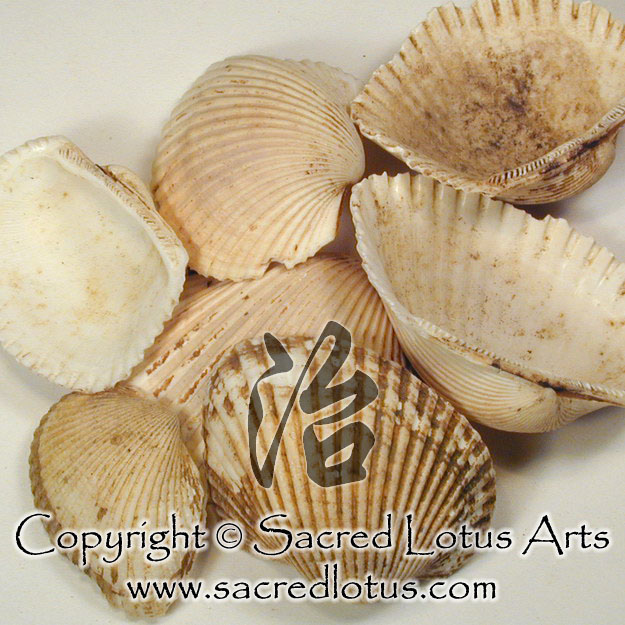
Wa Leng Zi (Cockle Shell, Ark Shell)
Concha Arcae Inflatae Cockle Shell, Ark Shell
Materia Medica Data
- Temperature
- Neutral
- Nature & Flavour
- Sweet, Salty, Neutral
- Channels Entered
- LIV, SP
- Latin (pharmaceutical)
- Concha Arcae Inflatae
- Chinese
- 瓦楞子
- Tone Marks
- wă lèng zĭ
Chinese Herb Actions
What is Wa Leng Zi used for in Chinese medicine?
Wa Leng Zi is a seashell — almost entirely calcium carbonate — used for two quite different jobs: breaking up hard masses and phlegm nodules, and absorbing stomach acid. Our record classifies it as sweet, salty and neutral, entering the Liver and Spleen channels, among the herbs that invigorate blood and remove stagnation.
Its main traditional actions:
- Invigorates blood, dissolves phlegm, softens hardness, disperses nodules — fixed or mobile abdominal masses arising from blood stasis, qi stagnation or phlegm accumulation; also recorded here for scrofula and goitre, menstrual pain, chronic cough with phlegm, and enlargement of the liver and spleen. Its salty flavour is the classical rationale for softening what has hardened.
- Absorbs acid and relieves pain — acid reflux, gastric and duodenal ulcers, and chronic stomach pain with vomiting and acid regurgitation. This is the action most people actually meet it for, and the one its calcium carbonate composition most obviously underwrites.
What it actually is: the shell of an ark clam, cleaned and dried. It is an animal-derived, mineral-type material — heavy, dense and largely inorganic — and it is not suitable for strict vegans or for anyone avoiding shellfish-derived products.
Source: Sacred Lotus sources & references (this herb’s recorded actions, category, nature, flavour, channels and Latin name, as held on file); published materia medica consensus (Bensky, Materia Medica 3rd ed.; Chen & Chen), cross-referenced against multiple online sources; composition per the analytical work cited in the research section. Traditional-use framing; not medical advice.
Chinese Herb Dosage
What is the typical dosage of Wa Leng Zi, and why must it be cooked so long?
9–30 g in decoction and 1–3 g as powder (Bensky), with Chen & Chen giving 10–30 g and the same 1–3 g powder dose. Our record adds the reason for the wide gap between the two figures: the shell “should be cooked a long time for maximum extraction of active components.” That note is well supported — calcium carbonate is poorly soluble, so a hard shell dropped into a short decoction gives up very little, while the same material taken as a fine powder is swallowed whole and needs a far smaller dose.
- Decoction — 9–30 g (Bensky) or 10–30 g (Chen & Chen), crushed and cooked first, ahead of the other herbs, as is standard for shell and mineral materials.
- Powder or pill — 1–3 g, agreed by both sources. Not interchangeable with the decoction figure.
- Why the two scales differ — an analytical comparison of ark shell and clam shell confirmed that the amount of calcium carbonate actually dissolving into a decoction is limited, and that it increases after the shell is calcined (PMID 38492563). Long cooking and prior processing exist for the same reason: to get anything out of a rock.
For comparison within the group: Zhen Zhu Mu (mother-of-pearl) is recorded on this site at 10–25 g cook-first, or roughly 1.5–3 g as levigated powder; Hai Piao Xiao (cuttlefish bone) at roughly 6–12 g in decoction or 1.5–3 g as powder for its acid-controlling use. The same pattern holds across all of them — large decoction dose, small powder dose.
Source: Sacred Lotus sources & references (the recorded ranges and the long-cooking note for Wa Leng Zi, and the recorded ranges for Zhen Zhu Mu and Hai Piao Xiao, as held on file); dissolution behaviour per PMID 38492563. Reference only — not a prescription.
Chinese Herb Contraindications & Cautions
Are there cautions for Wa Leng Zi?
Our record states “none noted,” and this is genuinely one of the gentler entries in a category full of harsh ones — it is a neutral, largely inert mineral material rather than a strong-moving herb. The sensible cautions are contextual: what it is made of, who should avoid it, and what else may be in a given batch.
- Shellfish-derived (dietary, ethical and allergy reference note) — this is a mollusc shell. It is not suitable for strict vegans, and anyone with a shellfish allergy should know the origin before taking it. Our record notes a single reported allergic reaction.
- Blood-invigorating category caution — herbs in this group are conventionally avoided or used only under professional supervision in pregnancy, and are not indicated where there is deficiency without stagnation. Best used under a qualified practitioner.
- It is a calcium load — at 9–30 g of a material that is largely calcium carbonate, this is a meaningful calcium intake. Anyone with hypercalcaemia, kidney stones, kidney impairment, or already taking calcium supplements or calcium-based antacids has an obvious reason to raise it with their prescriber. Precautionary, based on composition.
- Preparation matters — it must be crushed and cooked first for a decoction to contain anything (see dosage), and the calcined and raw forms are used for different actions (see notes). Its density and preparation requirements make it unsuitable for casual self-dosing.
- Contaminants in marine shell medicinals (quality reference note) — a survey of marine-derived Chinese medicines from two commercial suppliers detected microplastics in every product tested, including calcined Concha Arcae, at 0.07 to 9.53 items per gram, predominantly transparent fibres under 2 mm (PMID 37356768). A separate study of five pharmacopoeial shell medicines found trace-element profiles differing systematically between them, with arsenic among the elements measured in ark shell (PMID 27071261). These are findings about market material and quality control, not about the herb’s traditional action.
Source: Sacred Lotus sources & references (recorded cautions, “none noted,” the single allergic-reaction note, and the long-cooking note, as held on file); category cautions per published materia medica consensus, cross-referenced against multiple online sources; contaminant findings per PMID 37356768 and PMID 27071261. Neutral reference disclosures, not usage instructions.
Chinese Herb Toxicity & Overdose
Is Wa Leng Zi toxic?
No. Our record notes only a single reported case of allergic reaction, and the material is not classed among the toxic materia medica. Chemically it is close to inert: analytical work on ark shell confirms calcium carbonate as the dominant constituent, present as aragonite in the raw shell and calcite after calcining, with calcium, sodium and strontium the most abundant elements and a small protein fraction that is largely destroyed by heating (PMID 38492563).
- The allergy signal — consistent with a mollusc-derived product; one case is recorded on this page, which is the honest scale of what is documented.
- The realistic concerns are quality, not intrinsic toxicity — trace-element and microplastic contamination have both been measured in commercial marine shell medicines (see cautions).
- The usual caveat — no formal clinical safety evaluation of Wa Leng Zi could be found. Absence of reported toxicity is not the same as having been tested.
Source: Sacred Lotus sources & references (recorded toxicity entry, as held on file); composition per PMID 38492563. Neutral reference facts — not a safety guarantee.
Herb-Drug Interactions
Does Wa Leng Zi interact with medications?
No clinical herb–drug interaction study exists for Wa Leng Zi, but its composition gives a reasonable basis for practitioner awareness. The material is largely calcium carbonate — the same compound used as a conventional antacid — and the herb’s own recorded indication is absorbing stomach acid. Two general consequences of taking a calcium carbonate antacid are therefore worth flagging as precautions rather than as findings: raising gastric pH can alter the absorption of medicines whose uptake depends on an acid stomach, and calcium can bind certain drugs in the gut so that less is absorbed — tetracycline and quinolone antibiotics, levothyroxine, bisphosphonates and iron salts are the usual examples.
- This is inference from composition, not a measured interaction for this herb. No pharmacokinetic study of Wa Leng Zi with any drug could be found.
- Practical position — anyone taking a medicine in those classes, or already on calcium supplements or calcium-based antacids, should mention any shell-derived herbal product to their prescriber.
(Precautionary, based on constituent class; flagged for practitioner confirmation.)
Western / Biomedical Research
Chinese Herb Clinical Studies & Research
Provided as research context — a summary of published biomedical study, not a therapeutic or medical claim.
Is there modern research on Wa Leng Zi (Concha Arcae)?
Yes — and almost all of it is analytical chemistry and quality control, not pharmacology. There are no clinical trials of the shell, and no laboratory study of its traditional indications could be verified. That is unsurprising for a material that is essentially crushed calcium carbonate.
- Calcination changes the material measurably — infrared, X-ray and X-ray fluorescence spectroscopy plus thermogravimetric analysis of ark shell and clam shell from several production regions showed the calcium carbonate crystal form shifting from aragonite to calcite on calcining, protein content dropping significantly, and calcium carbonate dissolution in the decoction increasing afterwards — which the authors state aligns with the clinical use of calcined shell medicines (PMID 38492563; DOI 10.1093/jaoacint/qsae023). An earlier study quantified calcium carbonate decomposition at different calcining temperatures and compared commercially calcined shell drugs from six cities (PMID 7576136).
- Telling the shells apart — a morphological and microscopic study of the five commonly used pharmacopoeial shell medicines — abalone shell, ark shell, clam shell, oyster shell and mother-of-pearl, named in the paper by their Chinese names including Walengzi — established that both whole drugs and their powders can be distinguished under normal and polarised light (PMID 26579467; PMC 4629281). Trace-element profiling by mass spectrometry (PMID 27071261) and near-infrared spectroscopy (PMID 25522614) have both been used to separate the same group.
- Quality risks in market material — microplastics were detected in every marine-derived Chinese medicine sampled from two suppliers, including calcined Concha Arcae (PMID 37356768).
- Nomenclature — a review of animal-derived materials in the Chinese Pharmacopoeia proposed taxonomic and Latin-name amendments for concha arcae among others (PMID 21046726).
Does the research on Arca inflata apply to Wa Leng Zi?
Mostly no, and this is an important distinction. There is a substantial pharmacology literature on Arca inflata — anti-tumour proteins and peptides, immunoregulatory glucans, antibacterial haemoglobin fragments — but it is all work on the animal’s soft tissue, not its shell. The papers state this explicitly: the anti-tumour protein J2-C2, for instance, was isolated “from the edible portion” of the clam (PMID 28688945). Related work covers an anti-tumour polypeptide (PMID 24317469; PMC 3877886), a pro-apoptotic peptide in colorectal cancer cells (PMID 35200639; PMC 8875476), a branched glucan with immunoregulatory activity (PMID 31552984), and an antioxidant and antibacterial protein (PMID 29733930).
Wa Leng Zi is the shell. Proteins and peptides from the meat cannot be attributed to a calcium carbonate shell, still less to a calcined one whose protein content is largely destroyed by heating (PMID 38492563). We record the flesh literature here so that readers meeting it under the species name know what it is and is not evidence for — not as support for the herb.
Honest summary: the traditional indications for this shell — masses, nodules and acid reflux — are untested by modern research. Its acid-absorbing use has an obvious chemical rationale in calcium carbonate; its mass-dispersing use does not have a modern mechanism, and we are not going to invent one.
Sources: PMID 38492563, DOI 10.1093/jaoacint/qsae023 (composition and structural change before and after calcination); PMID 7576136 (calcium carbonate decomposition on calcining); PMID 26579467, PMC 4629281 (morphological and microscopic characterisation of five shell medicines); PMID 27071261 (trace elements across five shell medicines); PMID 25522614 (near-infrared identification); PMID 37356768 (microplastics in marine-derived Chinese medicines); PMID 21046726 (proposed Pharmacopoeia amendments to animal-medicinal names); soft-tissue pharmacology of Arca inflata, cited for boundary purposes only — PMID 28688945, PMID 24317469 with PMC 3877886, PMID 35200639 with PMC 8875476, PMID 31552984, PMID 29733930. Research context, not a therapeutic claim.
Chinese Herb Notes
How does Wa Leng Zi compare with the other shell medicinals?
All of them are calcium carbonate; what separates them is which action the tradition assigns to that calcium carbonate. Wa Leng Zi is the one aimed at masses and nodules, and it is the shell filed here under blood-invigorating, where the others sit under spirit-calming, astringing, phlegm-transforming or wind-extinguishing. Here are the shell medicinals held here, set beside it.
- Wa Leng Zi (this page, Concha Arcae) — ark/cockle shell; sweet, salty, neutral; Liver and Spleen; invigorates blood, softens hardness, disperses nodules and masses, and absorbs acid. The mass-and-nodule shell.
- Ge Qiao (Concha Cyclinae Sinensis, clam shell — held here under the alternative names Ge Ke and Hai Ge Ke, and also written Hai Ge Qiao) — bitter, salty, neutral; Kidney, Lung and Stomach; filed under herbs that cool and transform phlegm-heat. The closest counterpart to this page: the analytical literature repeatedly treats ark shell and clam shell as a matched pair of similar composition and efficacy (PMID 38492563), and both are on the site. The contrast is what each is asked to soften. Wa Leng Zi works on masses — blood, qi and phlegm congealed into fixed lumps, from the Liver and Spleen. Ge Qiao works on phlegm-heat — thick yellow sputum in the chest, and nodules of the scrofula and goitre kind, from the Lung. Both absorb stomach acid, which is where their uses overlap most in practice; if you are choosing between them for reflux, the deciding factor is the pattern behind it — heat and phlegm point to Ge Qiao, stasis and masses to Wa Leng Zi. See our Ge Qiao page for that entry in full.
- Mu Li (Concha Ostreae, oyster shell) — salty, astringent, cool; Liver and Kidney; filed under substances that anchor, settle and calm the spirit. Also softens hardness and, calcined, controls acid — the shell whose brief overlaps Wa Leng Zi’s most.
- Zhen Zhu Mu (Concha Margaratiferae, mother-of-pearl) — sweet, salty, cold; Heart and Liver; anchors Liver yang, settles the spirit, brightens the eyes. Not a mass-dispersing herb.
- Zhen Zhu (Margarita, pearl) — sweet, salty, cold; Heart and Liver. The same mollusc’s nacre in its most concentrated and most expensive form; spirit-settling and topical.
- Shi Jue Ming (Concha Haliotidis, abalone shell) — salty, cold; Kidney and Liver; filed under substances that extinguish wind and stop tremors. The eye-and-Liver-yang shell; not used for masses, and the member of the group furthest from Wa Leng Zi in purpose.
- Hai Piao Xiao (Os Sepiae, cuttlefish bone) — salty, astringent, slightly warm; Kidney, Liver, Stomach; filed under herbs that astringe, stabilise and bind. The acid-and-bleeding shell rather than the mass shell, and the closest comparison for the acid-reflux indication specifically.
Why is Wa Leng Zi usually calcined, and what does that change?
Calcining — heating the shell until it is brittle, then breaking it up — is the standard processed form, and it exists because it makes the shell give up more of itself. This is recorded here as reference fact about a pharmacy process; it is not a preparation instruction and should not be attempted domestically.
- What changes chemically — a comparative analysis of ark shell and clam shell before and after calcination found the calcium carbonate crystal form converts from aragonite in the raw shell to calcite in the calcined shell, protein content falls sharply, and the amount of calcium carbonate dissolving into a decoction rises — which the authors note aligns with the clinical preference for the calcined material (PMID 38492563). Earlier work measured the rate at which calcium carbonate decomposes at different calcining temperatures and used it as a simple quality check on commercially calcined shell drugs (PMID 7576136).
- What changes traditionally — the raw shell is the form emphasised for dispersing masses and nodules; the calcined shell is emphasised for absorbing acid and relieving stomach pain. The same raw-versus-calcined split is recorded on our own Zhen Zhu Mu page, where the calcined form is described as astringent and topical while the raw form does the Liver-and-spirit work.
- Why it matters to a reader — a shop label saying “calcined” is not a formality. It signals which of the two traditional actions the material was prepared for.
Formula context: our own formula records do not currently link Wa Leng Zi to any formula, so no formula is named here.
Identity note flagged, not corrected: our Latin field reads Concha Arcae Inflatae, naming a single species (Arca inflata, also published as Anadara broughtonii). The pharmacopoeial heading in the analytical literature is the broader Arcae Concha, and a review of animal-derived materials in the Chinese Pharmacopoeia specifically proposed taxonomic and Latin-name amendments for concha arcae among fourteen other animal medicinals (PMID 21046726) — the recognised position being that more than one ark-clam species is dispensed under this name. We have left the field exactly as held; whether to broaden it is an owner decision.
Source: Sacred Lotus sources & references (the herb records for Wa Leng Zi, Ge Qiao, Mu Li, Zhen Zhu Mu, Zhen Zhu and Hai Piao Xiao — identity, alternative names, nature, flavour, channels and category — as held on file, and the absence of any formula link for this herb); the ark-shell/clam-shell pairing per PMID 38492563; calcination chemistry per PMID 38492563 and PMID 7576136; nomenclature per PMID 21046726. Reference facts, not preparation instructions.
Sources & References
Compiled and edited by Thomas Dehli, Founder & Editor, Sacred Lotus Updated
The information here is referenced from numerous sources — teachers, practitioners, class notes from Five Branches University, the books below, and the published research literature, with citations given as resolvable PubMed identifiers. Where sources disagree, I have flagged the discrepancies directly. If facts couldn't be verified, I have left them out. How we source our content.
Reference information for students and practitioners — not medical advice. Consult a qualified practitioner. Terms of use.
Chinese Herbs Books & References
 https://amzn.to/3WfB3DK
 https://amzn.to/3DR1VUh
 https://amzn.to/42aMz73
 https://amzn.to/3PuD4bt