
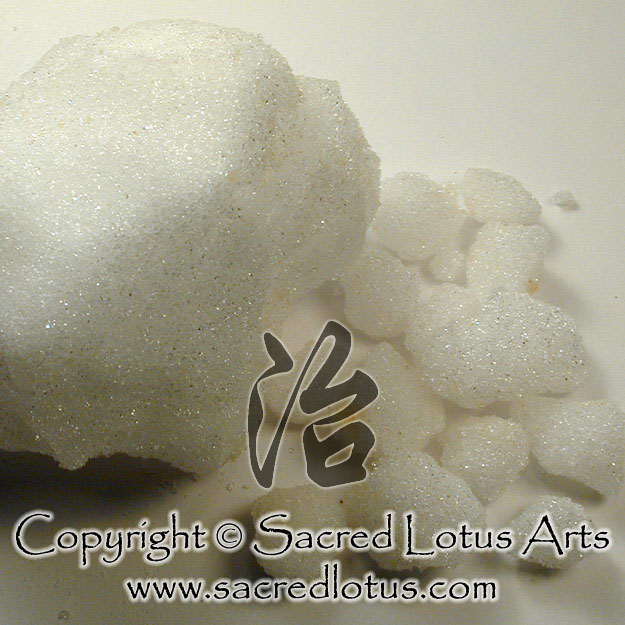
Materia Medica Data
- Category
- Substances for External Application
- Temperature
- Hot
- Nature & Flavour
- Spicy, Hot, Toxic
- Channels Entered
- HT
- Latin (pharmaceutical)
- Camphora
- Chinese
- 樟脑
- Tone Marks
- zhāng năo
Chinese Herb Actions
What is Zhang Nao (Camphor) used for in Chinese medicine?
Zhang Nao is a hot, acrid, strongly TOXIC aromatic substance used almost entirely topically — in medicated oils, liniments, and plasters — to dispel wind-cold-dampness, kill parasites, and relieve itching and pain for conditions such as tinea (ringworm), scabies, itchy sores, bruises, and sprains. A minor, classical internal use (tiny doses, opening the orifices for cold-type collapse) exists in the historical literature but is essentially superseded today given its toxicity.
Its main traditional actions:
- Dispels wind-cold-dampness and kills parasites (topical) — tinea/ringworm, scabies, and itchy sores; historically compounded into washes and ointments for fungal and parasitic skin conditions.
- Invigorates blood, reduces swelling, and stops pain (topical) — bruises, sprains, and traumatic injury with blood stagnation; a common ingredient in medicated oils and liniments for sore, stiff, or injured joints and muscles.
- Mild local anesthetic / counterirritant action — contributes to the warming, penetrating sensation of topical analgesic balms and plasters.
- (Minor, classical) opens the orifices and revives the spirit — for cold-type closed collapse with loss of consciousness; the opposite indication to the cooling orifice-opener Bing Pian (Borneol), which is used for heat-type collapse. This internal application is rare in modern practice.
Source: standard materia medica consensus (Bensky-aligned); multiple online sources. Traditional-use framing; not medical advice.
Chinese Herb Dosage
What is the dosage of Zhang Nao (Camphor)?
Zhang Nao is treated as an external-use-only substance in contemporary practice — ground to a fine powder, dissolved in wine/alcohol, or compounded into medicated oils, liniments, and plasters, typically in the low single-digit percent range (roughly up to 11% in over-the-counter topical products, the U.S. FDA’s regulatory ceiling for camphor in external analgesic drug products). Older materia medica describe a historical internal dose of only about 0.1–0.2 g in pills or dissolved in wine — but this internal use is rare, hazardous, and not part of routine modern practice.
Toxic dose ceiling (reference only): oral overdose signs begin at roughly 0.5–1 g (dizziness, a sensation of warmth); above ~2 g, nausea, vomiting, and CNS excitation with tonic-clonic seizures can occur; an oral dose of about 7–15 g is considered potentially fatal in an adult. See Toxicity for details, including the much lower thresholds documented in children.
Source: multiple online sources; U.S. FDA OTC External Analgesic Drug Products monograph (camphor concentration limit, 44 FR 69802). Reference only — not a prescription; not usage guidance.
Chinese Herb Contraindications & Cautions
Are there cautions or contraindications for Zhang Nao (Camphor)?
Zhang Nao is regarded as an external-use-only substance in contemporary practice because of its toxicity; internal use, where it appears at all in the classical literature, is a minor, rarely used application reserved for qualified practitioners. It is contraindicated in pregnancy — camphor crosses the placenta and the fetus lacks mature enzymes to metabolize it — and sources also caution against use during breastfeeding.
- Children — small children are disproportionately vulnerable; documented poisonings have followed both ingestion and topical over-application in toddlers (see Toxicity). Camphor-containing products are generally kept away from young children and not applied to infants’ or young children’s faces.
- Skin condition — not applied to broken, burned, or already irritated skin, which increases systemic absorption.
- TCM pattern caution — traditionally contraindicated in qi deficiency.
Source: multiple online sources; pediatric toxicology literature (see Toxicity). Reference note, not usage instructions.
Chinese Herb Toxicity & Overdose
High — Zhang Nao is classified as toxic in materia medica and is a well-documented cause of serious, occasionally fatal poisoning in Western toxicology, which is why it is treated as an external-use-only substance today. Reported oral thresholds: overdose signs (dizziness, a sensation of warmth) from roughly 0.5–1 g; nausea, vomiting, and CNS excitation with tonic-clonic seizures above ~2 g; an estimated fatal adult dose of about 7–15 g. Seizures can begin within minutes of significant exposure.
Children are disproportionately at risk. A Pediatrics case series describes three toddlers (15–36 months) who developed seizures after camphor exposure — two from ingestion, one from repeated skin application of an imported camphor product — all requiring medication to stop the seizures and one needing respiratory support. A 2023 case report describes a 61-year-old adult who ingested roughly 500 mL of liquid camphor oil and developed tonic-clonic seizures within minutes along with severe metabolic acidosis, requiring intensive care; he recovered after 48 hours. In the U.S., the FDA limits camphor to 11% concentration in over-the-counter topical products specifically because of this poisoning history.
Sources: PMID 19403490 (Pediatrics, 2009 — pediatric camphor-poisoning case series); PMID 38022187 (Cureus, 2023 — adult camphor oil toxicity case report); U.S. FDA OTC External Analgesic Drug Products monograph (camphor concentration limit, 44 FR 69802). Reference note, not a safety guarantee.
-
This herb is considered toxic.
(while some Chinese herbs are toxic, it must be noted that many come prepared, or are combined, to mitigate their toxicity)
Herb-Drug Interactions
No well-established clinical herb–drug interactions are documented for camphor. Because camphor is proconvulsant in overdose, practitioner caution is reasonable when combining topical camphor products with other agents that lower seizure threshold, and because high-concentration or occlusive topical use increases dermal absorption, layering it with other transdermal medications warrants care. These are precautionary, theoretical points rather than demonstrated clinical interactions. (Flagged for practitioner confirmation — absence of documented interactions is not proof of safety.)
Western / Biomedical Research
Chinese Herb Clinical Studies & Research
Provided as research context — a summary of published biomedical study, not a therapeutic or medical claim.
Is there modern research on Zhang Nao (Camphor, Cinnamomum camphora)?
Yes — camphor is one of the better-studied traditional substances in Western science, both for its topical pharmacology and, especially, for its toxicity. As the same molecule used in over-the-counter balms and liniments, its mechanisms and poisoning profile are independently documented outside TCM sources.
- Topical pharmacology (preclinical) — camphor activates and then strongly desensitizes the TRPV1 channel (and modulates TRPA1/TRPM8), a mechanism proposed to underlie the counterirritant, analgesic sensation of camphor-containing topical products; a broader review of Cinnamomum camphora bioactive molecules also reports preclinical anti-inflammatory (via prostaglandin E2/nitric oxide inhibition), antimicrobial, and wound-healing activity.
- Clinical evidence remains sparse — a 2023 bibliometric review of PubMed literature (2010–2022) on camphor- and menthol-containing agents found only 15 of 103 articles addressed clinical use, and just 2 were randomized controlled trials; the authors concluded the evidence is promising for pain, pruritus, and cold symptoms but not yet sufficient for a definitive clinical recommendation.
- Toxicology is the deepest evidence base — a pediatric case series and an adult case report (both cited under Toxicity) document seizures and, in severe cases, systemic metabolic derangement following camphor exposure, consistent with camphor’s traditional classification as toxic.
Overall, modern research supports camphor’s topical pharmacological actions while independently confirming the toxicity that restricts it to external use; it does not support internal use.
Sources: PMID 16192383 (camphor activation/desensitization of TRPV1); PMID 36246399, DOI 10.1155/2022/9354555 (Cinnamomum camphora bioactive molecules and pharmacological activities review); PMID 37546095, DOI 10.7759/cureus.41426 (bibliometric review of camphor/menthol clinical literature); PMID 19403490 (pediatric poisoning case series); PMID 38022187 (adult toxicity case report). Research context, not a therapeutic claim.
Chinese Herb Notes
How is Zhang Nao different from Bing Pian (Borneol) and other orifice-opening aromatics?
Zhang Nao and Bing Pian are both intensely aromatic, penetrating substances used topically for pain and, in tiny doses, to open the orifices — but their thermal nature is opposite and they are not interchangeable. Zhang Nao is hot and suits cold-damp patterns (frostbite, cold-type sprains, scabies); Bing Pian is cool and suits heat patterns (red, swollen eyes; sore throat; mouth sores). In modern practice Bing Pian is used far more often, including internally in small doses, while Zhang Nao’s greater toxicity has pushed it almost entirely into external use.
- vs Bing Pian (Borneol) — opposite temperature (hot vs cool); Zhang Nao for cold-damp topical conditions, Bing Pian for heat-type topical and orifice-opening use; never substitute one for the other.
- Common topical role — Zhang Nao is a frequent ingredient in medicated oils, liniments, and plasters for trauma, sprains, and skin parasites/itching, often alongside other externally applied blood-invigorating and antipruritic substances.
Note: Materia medica sources consistently place Zhang Nao in the Heart and Spleen channels; this site’s own record lists the Heart channel only. We believe this is an incomplete entry rather than a real discrepancy; the identity field is left unchanged pending owner review.
Source: standard materia medica consensus (Bensky-aligned); comparative summary via multiple online sources.com.
Sources & References
Compiled and edited by Thomas Dehli, Founder & Editor, Sacred Lotus Updated
The information here is referenced from numerous sources — teachers, practitioners, class notes from Five Branches University, the books below, and the published research literature, with citations given as resolvable PubMed identifiers. Where sources disagree, I have flagged the discrepancies directly. If facts couldn't be verified, I have left them out. How we source our content.
Reference information for students and practitioners — not medical advice. Consult a qualified practitioner. Terms of use.
Chinese Herbs Books & References
 https://amzn.to/3WfB3DK
 https://amzn.to/3DR1VUh
 https://amzn.to/42aMz73
 https://amzn.to/3PuD4bt