
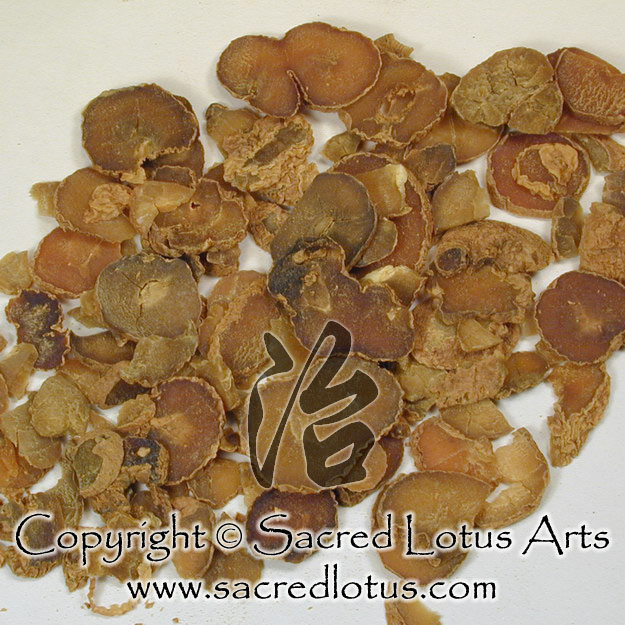
Corydalis Rhizome Corydalis Rhizome
Materia Medica Data
- Temperature
- Warm
- Nature & Flavour
- Spicy, Bitter, Warm
- Channels Entered
- HT, LIV, LU
- Latin (pharmaceutical)
- Corydalis Rhizome
- Chinese
- 延胡索
- Tone Marks
- yán hú suŏ
Chinese Herb Actions
What is Yan Hu Suo used for in Chinese medicine?
Yan Hu Suo (Corydalis Rhizome, Corydalis yanhusuo) is a spicy, bitter, warm herb entering the Heart, Liver, and Lung channels, traditionally regarded as one of the strongest single-herb pain relievers in the materia medica — it moves both qi and blood to stop pain arising from qi and blood stagnation anywhere in the body.
Its main traditional actions:
- Moves qi and invigorates blood to stop pain — chest and hypochondriac (rib-side) pain, epigastric and abdominal pain, hernial pain, and traumatic injury pain, all from qi-blood stagnation. Because it acts on both qi and blood, it is traditionally considered broader-acting and stronger than herbs that move only one or the other.
- Invigorates blood and regulates menstruation — painful, stagnant-type dysmenorrhea and irregular menstruation from blood stasis.
- Used for a wide range of pain presentations — classical and modern materia medica repeatedly describe Yan Hu Suo as effective for pain "anywhere in the body," reflecting its dual qi- and blood-moving action rather than a single target organ.
Source: Sacred Lotus sources & references, cross-referenced against multiple online sources (materia medica consensus).
Chinese Herb Dosage
What is the typical dosage of Yan Hu Suo, and does processing matter?
Commonly 3–10 g in decoction, or about 1.5–3 g when taken as a powder — the powdered form is traditionally favored for pain because grinding avoids prolonged heat exposure and is considered to deliver the active alkaloids more reliably than a long decoction.
Vinegar processing (Cu Yan Hu Suo): the rhizome is classically stir-fried with vinegar before use, a step traditionally said to help the herb "enter the blood level" and strengthen its analgesic effect. Modern chemical-analysis research supports a mechanism for this: vinegar (and wine) processing measurably increases the content of certain tertiary alkaloids extracted from the rhizome compared with the raw, unprocessed material, giving a plausible modern rationale for a centuries-old processing step.
Source: Sacred Lotus sources & references, cross-referenced against multiple online sources (standard materia medica ranges and processing notes); PMID 25093987, DOI 10.3390/molecules190811487 (vinegar/wine processing and alkaloid content, Molecules 2014). Reference only — not a prescription.
Chinese Herb Contraindications & Cautions
Are there cautions for Yan Hu Suo?
Yan Hu Suo is traditionally used with caution in pregnancy, given its strong blood-invigorating action, and is not indicated where there is no qi or blood stagnation to treat. Because its primary action is to strongly move blood, it is used cautiously in patients with bleeding disorders or a bleeding tendency.
Source: Sacred Lotus sources & references, cross-referenced against multiple online sources (materia medica cautions).
Chinese Herb Toxicity & Overdose
Low at standard therapeutic doses. Yan Hu Suo has a long history of use as a decocted or powdered analgesic herb with no significant toxicity reported at customary doses. The isolated compound dehydrocorybulbine (DHCB) studied in laboratory pain research (below) was tested at controlled experimental doses in animals, which is not equivalent to whole-herb dosing in traditional practice.
Source: materia medica consensus; laboratory pharmacology research (below), which used isolated compounds rather than the whole herb.
Herb-Drug Interactions
No well-established clinical herb–drug interactions are documented for Yan Hu Suo. Given its strong blood-invigorating action, practitioner awareness is reasonable for patients on anticoagulant or antiplatelet medication — this is precautionary, not a demonstrated clinical interaction. (Flagged for practitioner confirmation.)
Western / Biomedical Research
Chinese Herb Clinical Studies & Research
Provided as research context — a summary of published biomedical study, not a therapeutic or medical claim.
Is there modern research on Yan Hu Suo's pain-relieving alkaloids?
Yes — Yan Hu Suo has one of the better-documented pharmacological bases of any pain-relieving herb in the materia medica, centered on its isoquinoline alkaloids, though the strongest findings come from isolated-compound animal studies rather than human trials of the whole herb.
- Dehydrocorybulbine (DHCB) as a novel analgesic (animal model) — a widely cited 2014 study in Current Biology isolated DHCB from Corydalis yanhusuo and found it effective at reducing thermally-induced acute pain as well as inflammatory and neuropathic pain in rodent models; the compound showed dopamine-receptor activity rather than acting through opioid receptors, and the authors reported it did not produce reward-related behavior typical of opioid analgesics in their animal testing — a mechanistically distinct, non-opioid route to pain relief. This is an animal-model finding for an isolated compound, not a human clinical result.
- Dopamine-receptor-binding alkaloids (in vitro) — a separate study isolated eight isoquinoline alkaloids, including dehydrocorybulbine, from Corydalis yanhusuo and characterized their binding affinity at the dopamine D1 receptor, supporting a receptor-level explanation for the plant’s analgesic reputation.
- Alkaloid profiling in clinical use — a fingerprint-efficacy study of the quaternary alkaloids in Corydalis yanhusuo notes its longstanding clinical use "as an analgesic agent" and works to correlate its chemical alkaloid fingerprint with reported efficacy, supporting quality-control standardization of the crude drug.
Overall, the research base gives a credible pharmacological explanation for Yan Hu Suo’s traditional reputation as a strong analgesic, but the key mechanistic findings (DHCB, dopamine-receptor binding) come from isolated-compound animal and in vitro studies, not controlled human trials of the herb — this is research context, never a treatment claim.
Sources: PMID 24388848 (dehydrocorybulbine as a novel analgesic, Curr Biol 2014); PMID 18830156 (isoquinoline alkaloids, dopamine D1 receptor binding, Molecules 2008); PMID 28647508 (quaternary alkaloid fingerprint-efficacy study, J Ethnopharmacol 2017); PMID 25093987 (vinegar/wine processing and alkaloid content, Molecules 2014). Research context, not a therapeutic claim.
Chinese Herb Notes
What does Yan Hu Suo combine with, and how does it compare to other pain-relieving herbs?
Yan Hu Suo is distinguished among blood-invigorating, pain-relieving herbs by moving both qi and blood at once, which is why materia medica sources describe it as suited to pain of many different types and locations rather than one specific pattern.
- Jin Ling Zi San (Melia Toosendan Powder) — Yan Hu Suo is paired with Chuan Lian Zi (Melia Toosendan/Sichuan Chinaberry Fruit) for Liver-qi constraint transforming into heat, presenting as hypochondriac, epigastric, or hernial pain; this two-herb formula is one of the classic demonstrations of Yan Hu Suo’s qi-and-blood pain-relieving action, confirmed in Sacred Lotus formula records.
- Ju He Wan (Tangerine Seed Pill) — Yan Hu Suo appears alongside Ju He (Tangerine Seed) and other qi-regulating, blood-invigorating herbs for damp-cold invading the Liver channel causing hernial disorder (Shan pain), confirmed in Sacred Lotus formula records.
(Traditional formula context, not treatment advice.)
Source: Sacred Lotus sources & references (differentiation & combinations); Sacred Lotus formula records for Jin Ling Zi San and Ju He Wan.
Sources & References
Compiled and edited by Thomas Dehli, Founder & Editor, Sacred Lotus Updated
The information here is referenced from numerous sources — teachers, practitioners, class notes from Five Branches University, the books below, and the published research literature, with citations given as resolvable PubMed identifiers. Where sources disagree, I have flagged the discrepancies directly. If facts couldn't be verified, I have left them out. How we source our content.
Reference information for students and practitioners — not medical advice. Consult a qualified practitioner. Terms of use.
Chinese Herbs Books & References
 https://amzn.to/3WfB3DK
 https://amzn.to/3DR1VUh
 https://amzn.to/42aMz73
 https://amzn.to/3PuD4bt