
Yin & Yang in Chinese Medicine

Introduction to Yin and Yang
Yin and Yang (pronounced yong, as in 'gong') is one of the most fundamental concepts in Traditional Chinese Medicine (TCM), as it is the foundation of diagnosis and treatment. The earliest reference to Yin and Yang is in the I Ching (Book of Changes) in approximately in 700 BC. In this work, all phenomena are said to be reduced to Yin-Yang.

Yin
Translations
- Female, Passive
- Negative Principle in Nature
- The Moon
- Shaded Orientation
- North or Shady Side of a Hill
- South of a River

Yang
Translations
- Positive, Active
- Male Principle in Nature
- South or Sunny Side of a Hill
- North of a River
Four Main Aspects of Yin and Yang Relationship
- Yin-Yang are opposites
They are either on the opposite ends of a cycle, like the seasons of the year, or, opposites on a continuum of energy or matter. This opposition is relative, and can only be spoken of in relationships. For example: Water is Yin relative to steam but Yang relative to ice. Yin and Yang are never static but in a constantly changing balance. - Interdependent: Can not exist without each other
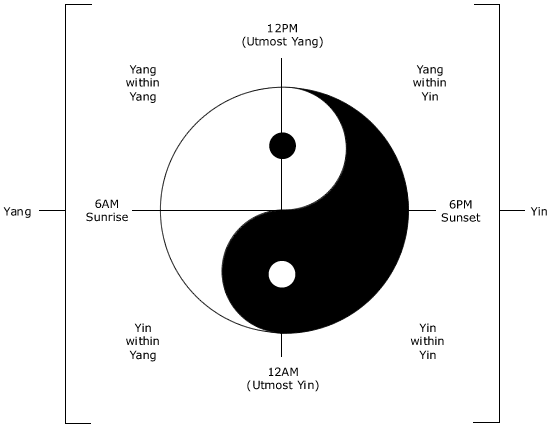
The Tai Ji (Supreme Ultimate) diagram shows the relationship of Yin & Yang and illustrates interdependence on Yin & Yang. Nothing is totally Yin or totally Yang. Just as a state of total Yin is reached, Yang begins to grow. Yin contains seed of Yang and vise versa. They constantly transform into each other. For Example: no energy without matter, no day without night. The classics state: "Yin creates Yang and Yang activates Yin". - Mutual consumption of Yin and Yang
Relative levels of Yin Yang are continuously changing. Normally this is a harmonious change, but when Yin or Yang are out of balance they affect each other, and too much of one can eventually weaken (consume) the other.
Four (4) possible states of imbalance:- Preponderance (Excess) of Yin
- Preponderance (Excess) of Yang
- Weakness (Deficiency) of Yin
- Weakness (Deficiency) of Yang
- Inter-transformation of Yin and Yang.
One can change into the other, but it is not a random event, happening only when the time is right. For example: Spring only comes when winter is finished.
Yin and Yang Theory and History
Yin Yang is the fundamental principle, and the most important theory in TCM, underlying all physiology, pathology & treatment.
Combining the two, we have the four stages of Yin and Yang...

With addition of an extra line, the Eight Trigrams (Ba Gua) were formed, illustrating all the directions.

The Eight Trigrams were combined to form 64 hexagrams, symbolizing all possible phenomena of the Universe.
Yin Yang had been understood for many centuries, but was systematically elaborated and written down by Tsou Yen of the Yin Yang (Naturalist) School in the Warring States Period (476-221 BC). 5 Element Theory was developed at same time.
The Naturalist school promoted idea of living in harmony with natural laws. Scholars of this school interpreted natural phenomena and observed how these are reflected in the human body in health and disease. Yin and Yang and the Five Elements became an integral part of Chinese philosophy.
The ancients observed 2 phases of constant cyclical change. Yin constantly changes into Yang & back into Yin again. This can be seen in the changes of four seasons, and the changes throughout a single day (24 Hour Cycle), as seen below.
24 Hour Yin Yang Cycle
12 PM corresponds to Utmost Yang, while 12AM corresponds to Utmost Yin
Yin and Yang in Medicine
All physiological processes, signs and symptoms can be reduced to Yin-Yang.
In general, every treatment modality aims to:
- Tonify Yang
- Tonify Yin
- Disperse excess Yang
- Disperse excess Yin
(In practice, depending on the condition, strategies may be combined, for example: disperse excess Yin & tonify Yang)
Front and Back
Front is more soft and vulnerable (Yin). Back contains spine that holds ribs: protection. When human depicted as crouching, back receives sun (Yang) and front faces the earth (Yin), is in shade and is protected.
All Yang channels (except the Stomach channel) flow on the dorsal or dorsolateral surface of the trunk and limbs. They carry Yang energy and protect the body from pathogenic factors. Yin channels flow on the anterior or anteromedial surface of the trunk and limbs.
Body and Head
Yang channels either end or begin on the head. Acupuncture points on the head can be used to raise Yang energy . When Yang energy is not cooled by Yin, it may rise to the head, causing signs such as red face and eyes. The head is easily affected by Yang pathogens such as heat and wind. The chest and abdomen (Yin) areas are more easily affected by Yin pathogens such as Cold and Dampness.
Interior and Exterior
The exterior of the body such as the skin and muscles is more Yang. The exterior protects body from attack by external pathogenic influences such as Cold, Wind, etc. The classics state: "Yang is on the outside and protects Yin".
Below the waist and Above the Waist
Below waist - closer to earth (Yin). Above, closer to Heaven (Yang).
Upper part more affected by Yang pathogens, i.e. wind.
Lower part more affected by Yin pathogens, i.e. cold damp.
Anterior/Medial and Posterior/Lateral Surface of the Limbs
Yin channels flow on anterior-medial aspect of trunk/limbs
Yang channels flow on posterior-lateral aspect of trunk/limbs
Structure and Function
Structure = something substantial, i.e. Matter (Yin)
Function = something insubstantial, action, energy (Yang)
All parts of the body have a structure (a physical form), and a function (their activity)
However, all is relative. Even within the Yang category of function, there are Yin functions (i.e. storage, conservation) and Yang functions, i.e. transformation, transportation, digestion, excretion.
Within the Yin category of form there are Yin forms ("solid") and Yang forms ("hollow")
Blood, Body Fluids, and Qi
Qi is Energy, more Yang.
Blood = denser and more material (therefore Yin).
But note that "Xue" (blood) not exactly like our concept of Blood. More like "thicker" form of Qi.
Note: there are several types of Qi. Each is relatively more Yin or Yang.
Ancestral QI (more Yin, more slow moving. Moves in long slow cycles).
Ying Qi (more Yang than Ancestral Qi, moves with Blood with which it is closely related). Ying is more Yin than Wei Qi.
Wei Qi the most Yang form of Qi. Circulates in the exterior in the daytime to protect us from pathogenic influences, and regulates opening/closing of pores.
Conservation/Store (Yin) and Transformation/Change (Yang)
Yin Organs store Blood, Body Fluids, Essence, etc.
Yang Organs constantly transform, transport and excrete the products of digestion.
Solid and Hollow Organs (Zang Fu)
Yin Organs are "Solid": constantly active, involved in production and storage of the body's vital Substances (Qi Blood, Body Fluids, Essence)
Yang Organs are "Hollow": receive and circulate but do not store, involved in digestion, transformation, excretion.
Yin and Yang in Pathology
Clinical signs and symptoms can be interpreted via Yin-Yang theory. When Yin Yang are in dynamic balance and relating harmoniously, there are no symptoms to observe. When Yin and Yang are out of balance, they become separated.
For example (Actual symptoms depend on specific pathologies, which Organ involved, etc.):
- When Yin does not cool and nourish Yang, then Yang rises
(headaches, red face, sore eyes, sore throats, nosebleeds, irritability, manic behavior) - When Yang does not warm and activate Yin
(cold limbs, hypo-activity, poor circulation of blood, pale face, low energy)
| Yin | Yang |
| Deficiency | Excess |
| Hypo-activity | Hyperactivity |
| Chronic disease/gradual onset | Acute disease/rapid onset |
| Slowly changing symptoms | Rapid pathological changes |
| Quiet, lethargy, sleepiness | Restlessness, insomnia |
| Wants to be covered | Throws off bedclothes |
| Lies curled up | Lies stretched out |
| Cold limbs and body | Hot limbs and body |
| Pale face | Red face |
| Weak voice, no desire to talk | Loud voice, talkative |
| Shallow, weak breathing | Coarse breathing |
| No thirst/wants warm drinks | Thirst esp. for cold drinks |
| Copious, clear urine | Scanty, dark urine |
| Loose stools (fluids not transformed) | Constipation (damage to fluids by heat) |
| Clear, copious secretions | Thick, sticky white/yellow secretions |
| Excessive moisture | Excessive dryness (throat, skin, eyes etc.) |
| Degenerative disease | Inflammatory disease |
| Pale tongue, white coat | Red tongue, yellow coat |
| Empty pulse | Full pulse |
In Practice:
Although Yin-Yang is essential for understanding symptoms and signs, the above list of signs is too general. We need to distinguish further to get exact diagnosis. i.e. - Which TCM Organ(s) involved, which pathogen(s) involved, which channel(s) involved.
Structure and Function - Without structure, function could not occur. Without function, structure would be meaningless.
Mutual Consumption of Yin and Yang - Balance of Yin & Yang is constantly changing. Yin & Yang mutually consume each other.
- Excess of Yin - i.e., when excess Cold in the body consumes the Yang (heat). This is an Excess Cold (Full Cold) condition.
- Excess of Yang - i.e., when excess Heat (from Exterior or Interior of body) consumes Body Fluids, leading to Dryness or even Heat. This is an Excess Heat (Full Heat) condition.
- Deficiency of Yin (Consumption of Yin) - i.e., when the body's Yin energy is depleted, an apparent excess of Yang results, leading to feelings of "empty heat" (mild but very specific heat symptoms, i.e., flushed cheeks, afternoon fever, sweating at night, heat in extremities. This is Deficiency Heat (Empty Heat) condition (i.e., a condition of deficiency and heat), also called "False Fire".
- Deficiency of Yang (Consumption of Yang) - When body's Yang energy is spontaneously deficient - an apparent excess of Yin results, leading to various symptoms involving cold and hypo-activity Deficiency of Yang can also occur after an Excess Cold condition has damaged Yang. This is an Deficiency Cold (Empty Cold) condition (i.e., a condition of deficiency and cold).
Inter-transformation of Yin and Yang in Medicine
In medicine also, Yin and Yang transform into one another, but only when conditions are right. The right moment determined by internal qualities of the given situation or phenomenon. In clinical practice, the above principle is very important.
Disease is prevented by living a balanced lifestyle, like the examples below.
- Excessive work (Yang) without rest leads to deficiency of Yin energy.
- Excessive consumption of cold food (Yin) leads to deficiency of body's Yang energy.
- Smoking (adding heat 'Yang' into Lungs) leads to deficiency of Yin of Lungs (and eventually Kidneys).
The principle is observable in pathological changes seen in disease, like the examples below.
- Exterior cold (cold weather) can invade body and can change to heat (sore throat).
- Deficiency of Spleen Yang can lead to Excess Interior Dampness (Yin), because the Spleen Yang is unable to properly transform fluids.


