
Medulla Junci Effusi Rush Pith, Juncus
Also known as Deng Cao, Deng Xin
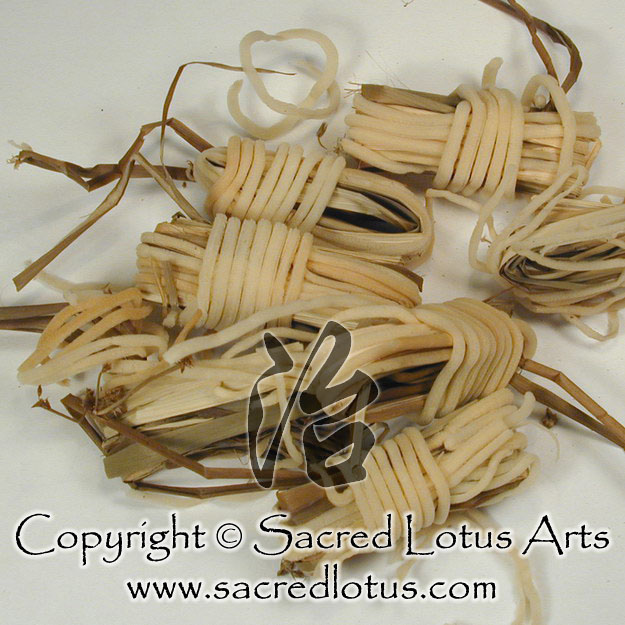
Materia Medica Data
- Temperature
- Slightly Cold
- Nature & Flavour
- Sweet, Bland, Slightly Cold
- Channels Entered
- HT, LU, SI
- Latin (pharmaceutical)
- Medulla Junci Effusi
- Chinese
- 灯心草
- Tone Marks
- dēng xīn căo
- Also Known As
- Deng Cao, Deng Xin
- Translation
- Lamp Wick Herb
Chinese Herb Actions
What is Deng Xin Cao used for in Chinese medicine?
Deng Xin Cao has two main jobs: it drains heat downward through the urine, and it settles an over-heated Heart — which is why it is used both for burning, scanty urination and for restlessness, irritability and disturbed sleep. It is sweet, bland and slightly cold, and enters the Heart, Lung and Small Intestine channels. The name means “lamp wick herb”: this is the white pith pulled from the stem of the soft rush, the material traditionally used as an oil-lamp wick.
Its traditional actions:
- Promotes urination and treats painful urinary dribbling (lin zheng) — a mild diuretic for hot, painful, dribbling urination and dark scanty urine, typically from damp-heat in the lower burner.
- Clears Heart heat and drains fire — irritability, restlessness and disturbed sleep. It is particularly associated with paediatric use: night crying, night terrors and restless sleep in small children. In adults it is used for insomnia and restlessness where Heart fire is not communicating with Kidney yin.
- Clears Lung heat — sore throat from heat in the Lung.
- Cools blood and stops bleeding (charred form) — when charred it cools the blood and stops bleeding from heat; left unprocessed it does the opposite job of regulating water flow and clearing heat. Our own record makes this processing distinction explicit.
The underlying logic is the Heart–Small Intestine relationship. Heart fire is drained through the Small Intestine into the urine, so the same herb that eases burning urination also calms an agitated spirit. Both of its two headline uses are the same mechanism seen from two ends.
Source: our own herb record (category “Herbs that Regulate Water and Drain Dampness”; sweet, bland, slightly cold; Heart, Lung, Small Intestine; raw-versus-charred note); published materia medica consensus (Bensky 3rd ed.; Chen & Chen), cross-referenced against multiple online sources. Traditional-use framing; not medical advice.
Chinese Herb Dosage
Why is the dosage of Deng Xin Cao so small?
Because the herb is almost nothing but air. Our record gives 1.5–2.5 g and 1.5–4.5 g in decoction — roughly a fifth to a tenth of the 9–15 g typical of most decocted herbs. That is not a sign of potency or toxicity. Deng Xin Cao is the dried pith of a rush stem: a spongy, feather-light white cylinder with almost no density. A 2 g dose of rush pith is a visually large handful, comparable in bulk to a much heavier weight of root or bark. The dose looks tiny because the herb weighs almost nothing, not because it is strong.
- Standard decoction — 1.5–2.5 g, or 1.5–4.5 g depending on the source. Some references go a little higher; up to about 9 g of the fresh material is sometimes cited.
- Bulk, not weight, is the practical guide — dispensaries often handle it in bundles or by volume, and it is sometimes counted in lengths of pith rather than grams.
- Charred form (Deng Xin Cao Tan) — used when the aim is to cool blood and stop bleeding rather than to move water.
- Preparation quirk — because the pith is so light and fluffy it floats and is awkward to cut or powder; it is commonly moistened before processing, and it is often added to a decoction bundled or wrapped rather than loose.
Source: our own herb record (both cited ranges); published materia medica consensus; physical description of the drug from the botanical and pharmacognostic literature. Reference only — not a prescription.
Chinese Herb Contraindications & Cautions
Are there cautions for Deng Xin Cao?
Deng Xin Cao is one of the gentler herbs in the materia medica, and its cautions follow from its cooling, water-draining nature rather than from any toxicity. Our record lists two:
- Cold or deficiency in the Middle Jiao — do not use. A cold, draining herb further weakens an already cold, weak digestion.
- Urinary incontinence — do not use. Promoting urination is exactly the wrong direction when urine is already leaking.
Additional points: as a diuretic-type herb it is inappropriate where fluids are already depleted — marked yin deficiency, dehydration, or profuse sweating. Its paediatric use is long-standing and traditional, but children should be treated by a qualified practitioner rather than self-dosed, and persistent night crying or sleep disturbance in a child deserves a proper assessment. Burning or painful urination can indicate a urinary tract infection, which is a medical matter.
Source: our own herb record cautions; published materia medica consensus. Reference note, not a safety guarantee — consult a qualified practitioner.
Chinese Herb Toxicity & Overdose
Low. Deng Xin Cao is regarded as a mild, non-toxic herb with a long record of use including in children, and our own record classifies it as neither toxic nor endangered. No significant toxicity is reported at the small doses in which it is used. The only routine caution is the ordinary one for cooling, water-draining herbs: it is unsuitable for cold, deficient or fluid-depleted patients rather than intrinsically harmful.
Source: our own herb record; published materia medica consensus. Reference note, not a safety guarantee.
Herb-Drug Interactions
Does Deng Xin Cao interact with medications?
No well-established clinical herb–drug interactions are documented. Two theoretical areas are worth practitioner awareness:
- Diuretic medication — a general caution for any herb used to promote urination; combining with prescription diuretics is a matter for the prescriber, particularly where electrolytes or fluid balance are already being managed.
- Renally cleared drugs (preclinical signal) — dihydrophenanthrenes isolated from Juncus effusus have been characterised as inhibitors of the organic anion transporters OAT1 and OAT3 (PMID 30892891). Those transporters handle the kidney’s secretion of a number of medicines. This is an in-vitro finding on isolated compounds, not on the crude herb at traditional doses, and no clinical interaction has been demonstrated — but it is a reasonable thing for a practitioner to be aware of in a patient on renally cleared drugs.
(Precautionary reference notes, not demonstrated interactions.)
Western / Biomedical Research
Chinese Herb Clinical Studies & Research
Provided as research context — a summary of published biomedical study, not a therapeutic or medical claim.
Is there modern research on Deng Xin Cao (Juncus effusus)?
Yes — and unusually, the research lines up neatly with the traditional calming use. The characteristic constituents of rush pith are phenanthrenes, above all effusol and dehydroeffusol. In a bioactivity-guided study using two-microelectrode voltage clamp on recombinant GABAA receptors, both compounds enhanced GABA-induced chloride currents in a concentration-dependent way and independently of the benzodiazepine binding site — the authors noted this may explain the herb’s traditional use as a sedative and anxiolytic in Chinese medicine (PMID 22271080, DOI 10.1055/s-0031-1298174). It is rare for a traditional indication and a laboratory mechanism to converge this directly.
- Sedative and anxiolytic (animal) — dehydroeffusol produced dose-dependent anxiolytic effects in the elevated plus-maze and hole-board tests in mice and reduced locomotion in the open-field test, without impairing motor coordination on the rota-rod (PMID 21104609). Further phenanthrenes from J. effusus showed comparable anxiolytic and sedative activity (PMID 22017742).
- Human trial (single, small, industry-funded, cognition endpoint) — a randomised, double-blind, placebo-controlled study in 41 older adults (average age 69) took a J. effusus extract powder enriched with dehydroeffusol once daily for 24 weeks and reported higher scores than placebo on clue-recall and clock-drawing tasks and on a dexterity assembly task, with no clinically observed adverse events (PMID 40068564, DOI 10.1016/j.nut.2025.112712). Note the limits carefully: very small sample, a single trial, a concentrated enriched extract rather than the decocted herb, cognition rather than any traditional indication, and funding and test material supplied by the manufacturers. Preliminary at best.
- Charred form (animal) — both J. effusus and carbonised J. effusus reduced markers of D-galactosamine-induced acute liver injury in mice via the Nrf2 pathway, with the carbonised form performing best (PMID 38325836, DOI 10.1248/cpb.c23-00578). Interesting as a laboratory counterpart to the traditional raw-versus-charred distinction, though liver injury is not a traditional indication for the herb.
- Anti-inflammatory (in vitro) — a water extract reduced inflammatory markers in oral keratinocytes (PMID 35028318).
- Aroma of the dried rush (human, small) — a study of volatile organic compounds from dried common rush reported physiological and psychological relaxation effects in human participants (PMID 35162880, PMC 8834784, DOI 10.3390/ijerph19031856). Of interest given the material’s use in tatami mats; not a test of the medicinal preparation.
Apart from the one small trial above, this is laboratory and animal work. It supports the plausibility of the traditional calming use; it does not establish clinical efficacy for anything.
Note on our existing research entry: our record carried a citation to a 1983 Chinese-language clinical report of a rush-pith and tofu decoction in 30 cases of chronic nephritis. That source could not be independently verified from the available indexes, so it has not been carried forward here. The two chemistry papers previously listed (antialgal dihydrophenanthrenes, and antimicrobial DNA-binding photosensitizers) concern the plant’s ecology and photochemistry rather than its medicinal use, and have likewise been set aside in favour of the pharmacological literature above.
Sources: PMID 22271080, DOI 10.1055/s-0031-1298174; PMID 21104609; PMID 22017742; PMID 40068564, DOI 10.1016/j.nut.2025.112712; PMID 38325836, DOI 10.1248/cpb.c23-00578; PMID 35028318; PMID 35162880, PMC 8834784, DOI 10.3390/ijerph19031856; PMID 30892891 (transporter inhibition). Research context, not a therapeutic claim.
Chinese Herb Notes
How does Deng Xin Cao compare with Zhu Ye and Mu Tong?
All three drain heat through the urine, but they differ in strength and in where their emphasis falls. Our own record sets out the comparison:
- Deng Xin Cao vs Zhu Ye — Deng Xin Cao is better for painful urination with a burning quality; Zhu Ye is the more effective of the two for irritability and insomnia in adults.
- Deng Xin Cao vs Mu Tong — Mu Tong clears Small Intestine heat through the urine more effectively. Mu Tong is bitter and cold; Deng Xin Cao is sweet, bland and only slightly cold, which makes it the gentler herb of the two.
The pattern across all three: Deng Xin Cao is the mildest member of this group. That mildness is the reason it is favoured in children and in frail patients, and the reason it is more often a supporting herb in a formula than the lead.
Raw or charred — does the processing change what it does?
Yes, and this is one of the clearer examples of processing changing a herb’s direction. Unprocessed Deng Xin Cao regulates water flow and clears heat. Charred (Deng Xin Cao Tan), it cools the blood and stops bleeding instead. A prescription that specifies the charred form is not asking for the same action.
Which formulas contain Deng Xin Cao?
In our own collection Deng Xin Cao appears in two formulas, which between them cover both halves of its character: Ba Zheng San (Eight Herb Powder for Rectification), a strongly draining formula for damp-heat painful urinary dribbling, and Ding Xian Wan (Arrest Seizures Pill), where the Heart-clearing, spirit-settling side of the herb is what is wanted. (Traditional formula context, not treatment advice.)
Source: our own herb record (comparison notes with Zhu Ye and Mu Tong; raw-versus-charred note) and our own formula links; published materia medica consensus. Traditional context only.
Sources & References
Compiled and edited by Thomas Dehli, Founder & Editor, Sacred Lotus Updated
The information here is referenced from numerous sources — teachers, practitioners, class notes from Five Branches University, the books below, and the published research literature, with citations given as resolvable PubMed identifiers. Where sources disagree, I have flagged the discrepancies directly. If facts couldn't be verified, I have left them out. How we source our content.
Reference information for students and practitioners — not medical advice. Consult a qualified practitioner. Terms of use.
Chinese Herbs Books & References
 https://amzn.to/3WfB3DK
 https://amzn.to/3DR1VUh
 https://amzn.to/42aMz73
 https://amzn.to/3PuD4bt